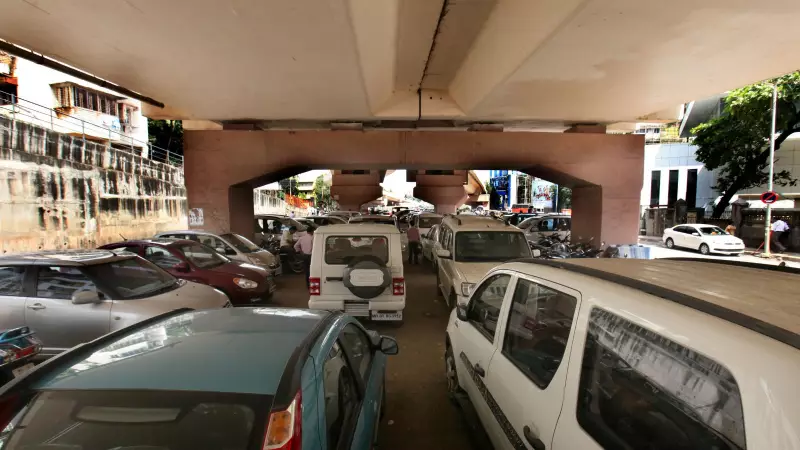
As Mumbai prepares for crucial Brihanmumbai Municipal Corporation (BMC) elections on January 15, after a four-year delay under administrator's rule, one civic issue screams for the immediate attention of the incoming elected representatives: the city's crippling parking crisis. The problem, persistently overlooked under both mayoral and administrator regimes, now threatens to choke the metropolis completely.
Alarming Numbers: Highest Vehicle Density, Lowest Road Length
The statistics paint a dire picture. Mumbai holds the dubious distinction of having the highest vehicle density among all Indian metro cities. Recent state government data reveals a staggering density of 2,300 cars per kilometre. This number has skyrocketed from 1,150 cars/km in 2014 to 1,840 cars/km in 2019, showcasing a relentless upward trend.
In stark and troubling contrast, Mumbai's road infrastructure is the most inadequate. The city has a total road length of only 2,050 km, the lowest among major metros. Compare this to Delhi's 33,000 km, Bengaluru's 12,800 km, Kolkata's 4,018 km, and Chennai's 2,780 km. The mismatch is colossal.
Compounding the problem is the relentless addition of new vehicles. Regional Transport Office (RTO) data shows 3.02 lakh vehicles were registered in Mumbai in 2025 alone, following 2.79 lakh registrations in 2024. With nowhere to go, these vehicles clog roads and footpaths, exacerbating daily traffic snarls and endangering pedestrians.
Inadequate Infrastructure and a Policy in Limbo
The BMC's current parking facilities are hopelessly insufficient. The civic body operates 26 off-street parking lots and over 350 on-street parking lots across the island city and suburbs, including congested areas like Nariman Point and Colaba. These on-street facilities often worsen traffic flow.
Experts warn that the city's roads are operating far beyond capacity. Vivek Pai, a transport expert and urban planner with the Mumbai Mobility Forum (MMF), emphasized the urgency. "If 80 per cent of people decide to bring out their vehicles on a single day, the entire road network of Mumbai will get choked," he stated, referencing a 2018 MMF survey.
Pai argues that the newly elected corporators must prioritize a scientific parking policy. "The first step is to identify and quantify all available parking spaces in Mumbai. We need a clear idea of the gap between demand and supply before chalking out an effective policy," he added.
Despite recognition of the crisis, a solution remains elusive. The BMC drafted its first parking policy in 2017 and later proposed a Mumbai Parking Authority (MPA) in 2021. The MPA, endorsed by former Mayor Kishori Pednekar, was envisioned as a dedicated body to upgrade and regulate parking infrastructure, integrating spaces from housing societies and enabling app-based bookings. However, eight years since the initial policy was proposed, it has not been implemented.
A senior BMC official revealed that the proposal, which requires an amendment to the Mumbai Municipal Corporation Act (MMC), was sent to the state government for approval. "We are awaiting clearance," the official said, citing the absence of an elected civic body as a hurdle.
Stalled Projects and Political Promises
Parallel efforts to build new parking infrastructure have also stalled. A plan to construct facilities for 400-600 vehicles along the coastal road was halted after residents complained about dust and noise pollution. Another tender for a parking facility in Mahim was rolled back due to poor response from bidders.
With polls around the corner, former corporators and candidates are highlighting parking as a key agenda. Makarand Narwekar, a former Colaba corporator and BJP candidate contesting for the third time, stated, "My key agenda is to make the entire Colaba-Churchgate area parking- and pedestrian-friendly. A proper policy is needed to tackle illegal hawking and parking chaos."
Echoing the sentiment, former Worli corporator Samadhan Sarvankar, contesting again, warned, "Mumbai's ongoing infrastructure churn will bring more vehicles from the MMR region. We need a robust policy to ensure the city's roads don't get completely blocked in the future."
The message is clear: as Mumbai votes for its civic leadership, the demand for a concrete, actionable, and holistic parking policy has never been more critical. The city's mobility and livability depend on the choices made by its next set of administrators.