

Nagpur's Beltarodi Residents Fume as New Roads Dug Up for Utilities
Rapid residential expansion in Beltarodi has once again exposed significant gaps in urban planning, with local residents bearing the brunt of uncoordinated infrastructure execution. Cement concrete roads, laid just months ago, are now being dug up to accommodate underground utilities, triggering widespread anger among locals who allege gross wastage of public funds and avoidable civic hardship.
Poor Coordination in Infrastructure Projects
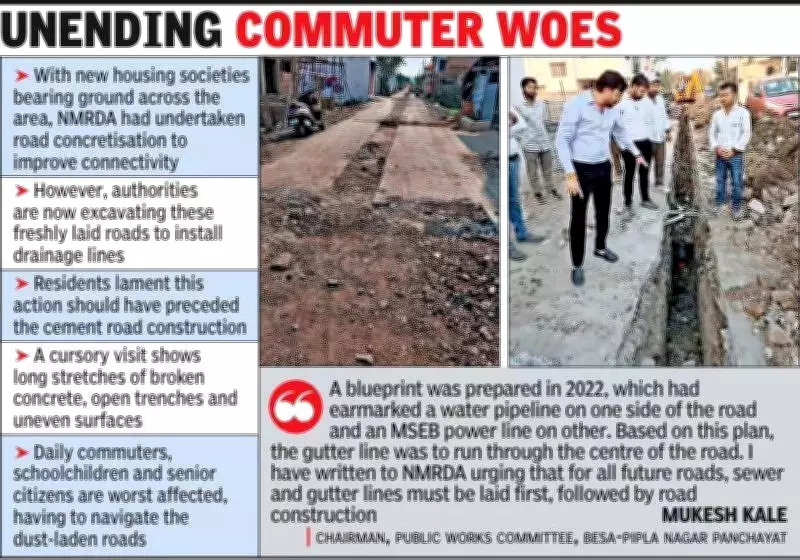
With several new housing societies mushrooming across the area, the Nagpur Metropolitan Region Development Authority (NMRDA) had earlier undertaken road concretisation to improve connectivity. However, authorities are now excavating these freshly laid cement roads to install drainage lines, an exercise that residents argue should have preceded road construction. This lack of foresight has led to severe disruptions and public outcry.
On-Ground Chaos and Public Inconvenience
A visit to the localities reveals long stretches of broken concrete, open trenches, and uneven surfaces, severely disrupting traffic movement. Daily commuters, schoolchildren, and senior citizens are among the worst affected, forced to navigate dust-laden roads and unsafe passages. Residents complain that the repeated digging not only causes immense inconvenience but also raises serious concerns over safety and the long-term durability of the roads.

"There is no logic in first spending crores on cement roads and then digging them up within months. This reflects poor coordination and planning," said resident Abhijeet Kale, echoing the frustration of many in the community.
Official Explanation and Systemic Issues
Speaking to the media, Mukesh Kale, chairman of the public works committee of Besa Pipla Nagar Panchayat, clarified that the road works are part of a larger 126-crore infrastructure project being executed by NMRDA. "A detailed blueprint was prepared in 2022, which clearly earmarked a water pipeline on one side of the road and an MSEB power line on the other. Based on this plan, the gutter line was proposed to run through the centre of the road," Kale explained.
He added that the responsibility of restoring the road lies with NMRDA. "Once the gutter lines are laid, a mandatory 15-day period is given for soil settlement. Only after that is the cement concrete road relaid. All sewer lines will ultimately connect to a sewage treatment plant (STP) at Ensara Layout," Kale detailed.
Calls for Improved Planning
Kale admitted that the sequencing of works has highlighted systemic issues in urban development. "I have written to NMRDA urging that for all future roads, sewer and gutter lines must be laid first, followed by road construction. This will prevent repeated excavation and public inconvenience," he stated, emphasizing the need for better coordination to avoid such scenarios in the future.
The situation in Beltarodi underscores the critical need for integrated urban planning, where infrastructure projects are executed in a logical sequence to minimize disruption and maximize efficiency. As residents continue to grapple with the fallout, the incident serves as a stark reminder of the challenges posed by rapid urbanization and the importance of proactive governance in public works.






