Nagpur Civic Workers Burn Garbage, Exposing Weak Enforcement of Waste Rules
In a blatant disregard for solid waste management regulations, sanitary workers were discovered burning piles of collected garbage in Friends Colony on Friday. This incident underscores the Nagpur Municipal Corporation's inadequate enforcement mechanisms and the trivial penalties that have failed to deter a practice that is widespread throughout the urban area.
Residential Areas Engulfed in Toxic Smoke
Dense clouds of smoke filled residential streets as workers allegedly opted to incinerate gathered waste instead of transporting it to designated collection points. According to municipal guidelines, each sanitary worker is responsible for a 500 to 900 meter section and must accumulate waste at specified spots for proper disposal. However, burning—viewed as the fastest and most economical alternative—persists without significant intervention.
The Nagpur Bench of the Bombay High Court previously took suo motu notice of a similar garbage burning case following a report by The Times of India. Although the court's involvement was anticipated to deliver a powerful message, years later, minimal progress has been observed on the ground.

Resident Complaints and Official Inaction
Yogita Khan, a resident of CPWD Colony, witnessed workers setting garbage ablaze and promptly notified the NMC's Solid Waste Management department. "This is a common occurrence within CPWD Colony as well. Despite numerous complaints, no substantial measures have been implemented," she stated. Efforts to reach Junior Engineer Rishi Soni from CPWD were unsuccessful.
Senior officials within the SWM department acknowledged that the penalty for such infractions is a mere Rs 500 if a worker is apprehended. "Whenever we identify any individual, including sanitary staff, we impose a fine," an officer remarked. Critics contend that this nominal fee neither accounts for the environmental harm nor serves as an effective deterrent.
Systemic Enforcement Failures Across the City
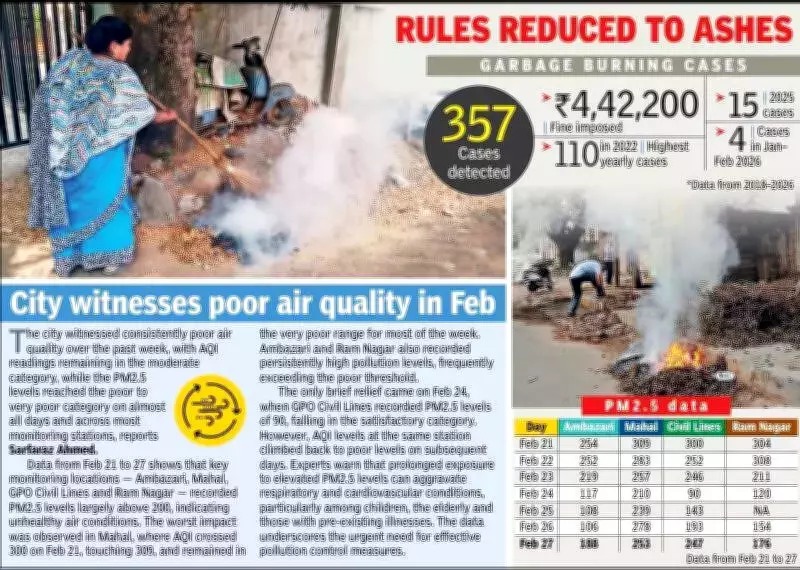
Civic authorities privately admitted that garbage burning is not confined to a single locality. "It is prevalent across the entire city," an officer revealed, pointing to a systemic breakdown in enforcement. Data from the Nuisance Detection Squad indicates that only 357 cases of garbage burning were registered between January 1, 2018, and February 27, 2026, with fines totaling Rs 4.42 lakh.
In 2022 alone, 110 cases were documented. By 2025, merely 15 cases were recorded, with an additional 4 in the initial two months of 2026. For a city where residents frequently report smoke from burning waste, these statistics seem drastically underreported. Environmental advocates assert that hundreds of such incidents go unrecorded, with no punitive actions taken.
Blurred Accountability and Limited Authority
Even in instances where violations are detected—such as at CPWD Colony, previously identified as a Garbage Vulnerable Point—responsibility remains ambiguous. On Friday, the NDS issued a notice to the sweeper contractor, but no accountability was assigned to CPWD officials. Municipal authorities conceded they possess restricted power to penalize central government establishments.
As hazardous smoke continues to suffocate neighborhoods, the disparity between regulatory frameworks and actual practices widens, with enforcement often reduced to a mere formality. This ongoing issue highlights the urgent need for stricter penalties and more robust monitoring to protect public health and the environment.