

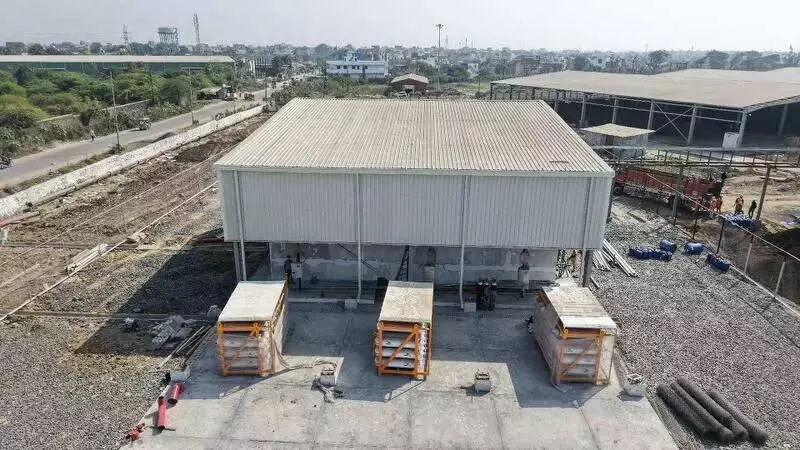
Nagpur took a significant stride towards transforming its waste management landscape on Sunday with the cold commissioning of its upcoming compressed biogas (CBG) plant at the Bhandewadi dumping yard. This pivotal step edges the city closer to establishing itself as a national benchmark for scientific waste processing.
Initiating the Microbial Process
The commissioning event marked the crucial initiation of the plant's dry fermentation culture. Officials unveiled a full-plant model and activated the fermentation tank, kickstarting a 45 to 60-day biological process. During this period, a stable culture of specialized bacteria—including hydrolytic, acidogenic, acetogenic, and methanogenic microbes—will be established. The microbial consortia will be under continuous monitoring with strict mesophilic temperature control to ensure optimal activity and maturity before full-scale operations begin. Simultaneously, biogas tunnels are being prepared for feedstock loading to enable seamless integrated dry fermentation once the culture stabilizes.
A Glimpse at India's Largest MSW-to-CBG Facility
The inspection of the facility was attended by key officials including Municipal Commissioner Abhijeet Chaudhari, Additional Municipal Commissioner Vasumana Pant, Superintending Engineer (Public Health Engineering) Shweta Banerjee, Netherlands-based researcher Vrinda Thakur, Director (Finance and Business Development) Vinod Tandon, and VP Vijay Chiplunkar.

Spread across 30 acres of Nagpur Municipal Corporation (NMC) land, the Bhandewadi project is now transitioning from structural development to early operational testing. Developed by LOC Nagpur Pvt Ltd, backed by the Keva Group and Netherlands-based Waste Treatment Technologies (WTT), the plant is progressing toward its rescheduled commissioning deadline of March 2026. The civic body had granted a four-month extension due to the prolonged monsoon. Hot commissioning will follow in three distinct phases.
Designed for Scale and Indian Conditions
Although the NMC's tender required processing 1,000 Metric Tonnes Per Day (MTPD) of unsegregated waste, the company proactively built a 1,500 MTPD facility. This forward-thinking approach accommodates Nagpur's future waste load and positions the plant among the largest dry fermentation municipal solid waste (MSW) plants in the world.
The project's credibility is bolstered by a unique mandate that required proof of technology on actual mixed Indian waste. A mobile pilot plant installed on-site in December 2024 successfully demonstrated that European-style dry fermentation could effectively handle India's challenging high-moisture, high-contamination waste streams.
Operational Impact and Economic Model
Once fully operational, the plant is designed to convert 550-600 Tonnes Per Day (TPD) of organic waste into CBG across 30 fermentation tunnels. It will also generate approximately 400 TPD of Refuse-Derived Fuel (RDF) and direct less than 10% of inert waste to a scientific landfill.
Engineered as a zero-tipping-fee, zero-discharge model, the facility represents a financially sustainable solution. It will not only operate at no cost to the NMC but is also structured to provide royalty income to the civic body, creating a virtuous cycle for urban waste management.
This landmark project underscores Nagpur's commitment to innovative environmental solutions and sets a powerful precedent for other Indian cities grappling with the dual challenges of waste management and clean energy generation.






