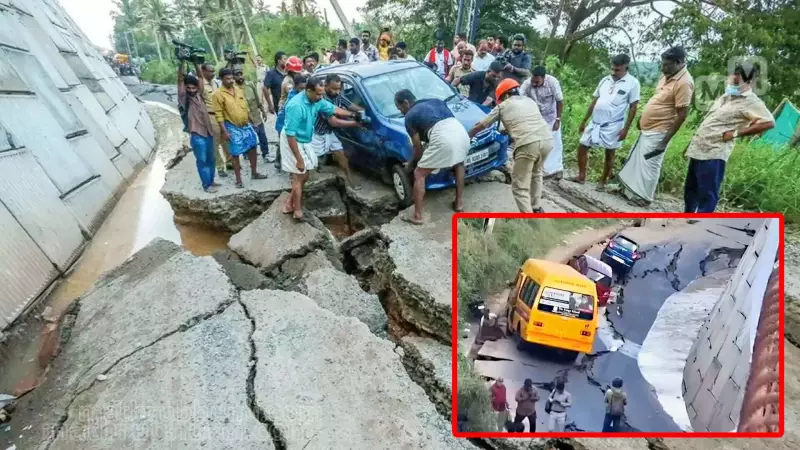
A newly built section of National Highway 66 in Kerala's Kollam district suffered a major collapse on Friday, raising urgent questions about the safety and quality of infrastructure projects in the state. The incident led to several vehicles, including a school bus, being trapped in deep craters that suddenly opened up on the road.
Details of the Highway Collapse
The embankment failure occurred around 3:30 pm on December 7, 2025, along the Mevara–Kadampattukonam section at Mylakkadu near Kottiyam. A portion of the under-construction service road also caved in simultaneously. Authorities confirmed that despite the severity of the collapse, all passengers from the trapped vehicles were safely rescued. The area has been cordoned off for a detailed structural assessment by officials.
Official Response and Suspected Causes
Officials from the National Highways Authority of India (NHAI) stated that the exact cause of the collapse is still under investigation. Preliminary suspicions point towards the challenging paddy-field terrain in the region, which may have contributed to the structural failure. However, this explanation has been met with skepticism from political figures.

Congress MP K C Venugopal directly blamed the incident on poor construction quality and corruption. He cited repeated failures of newly built roads in Kerala as evidence of systemic issues in project execution and oversight.
Broader Implications and Public Safety
This collapse has triggered serious public concern regarding the durability of ongoing highway projects across Kerala. It is not an isolated event but part of a worrying pattern of infrastructure failures. The incident disrupts a critical transport corridor and underscores the need for rigorous quality checks, especially in geologically sensitive areas.
The structural assessment currently underway will be crucial in determining whether the failure was due to natural ground conditions, as suspected by NHAI, or flaws in engineering and construction, as alleged by the MP. The findings will have significant implications for future highway projects in similar terrains across India.