

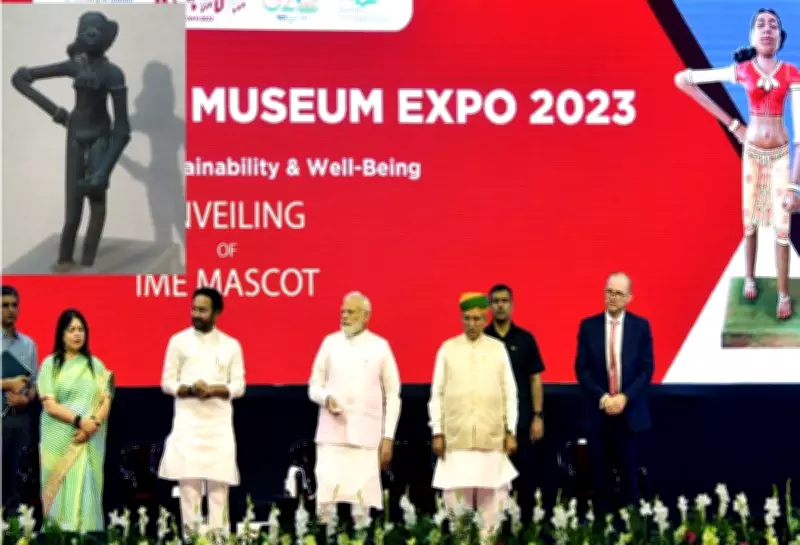
The photograph of an exquisitely cast six-inch (10.5 cm) ancient bronze figurine of a nude girl from Mohenjo Daro triggered a furore among the creators of Madhurima, a new arts series for schoolchildren. It had long been a mote in the eyes of those scanning traditional arts through a prudish lens. Three years ago, when Prime Minister Narendra Modi inaugurated the prestigious International Museum Expo in 2023, the figurine was its chosen mascot.
The government handout accompanying it said it was "a contemporised version of the Dancing Girl." Make what you will of it. So, finally, the contemporised version resulted in the image being clothed in a most garish pink garment that covered its shoulders and upper torso entirely.
NCERT has since relented and returned the Mohenjo Daro girl to her original condition. But the ethical implications were clear. No matter how beautifully cast the original bronze statue was, how marvellous was the craftsmanship of its creators who used the 'lost wax' process 4,000 years ago, no Indian nude statue on display should be permissible.

Historical Nudity in Indian Art
It is strange that nudity has begun to bother the ruling BJP whose Hindu ancestors had commissioned exquisite erotic figures at Khajuraho and Konark temples, where nude or semi-nude couples can be seen making love all over the temples' walls and friezes.
Interestingly, until 2010, the Encyclopaedia Britannica had a sentence about Lord Shiva being worshipped in the form of a phallus (lingam), often embedded in a yoni. In response to the growing pressure from a fast-burgeoning group of Hindu guardians of public morality, it had to change the definition of lingam to "a cylindrical votary object embedded in a yoni or spouted dish."
Post 2014, the clout of this lobby has obviously grown to the extent that heated protests were raised against semi-nude paintings of the Indian goddess of learning, which was one of the reasons why a painter like MF Husain exiled himself to a West Asian country for the rest of his life.
Impact on School Curriculum
So, it is no longer surprising, shameful though it is, that the government bodies in charge of creating texts for schoolchildren were in denial about the presence of a whole gallery of ancient nude statues and paintings from past centuries. Never mind that poems of female ascetics, like the 12th century Veerashaiva poetess Akka Mahadevi and Lal Ded, the 14th century Shiva devotee from Kashmir, continue to be sung.
Has a thought been spared about how instead of sensitising schoolchildren about both the literal and symbolic levels of nudity in Indian arts and society through the ages, the creators of Madhurima are launching a debate about the viability of placing the figure (named 'The Dancing Girl' by Sir John Marshall) in textbooks meant for Class IX kids? We do not even know if the figurine depicts a dancing girl or a devotee like Akka Mahadevi, standing happily, unselfconsciously in all her nude glory, holding a bowl in one hand and the other resting on her hips.
Not too long ago, when scholar Michel Denino was heading the textbook committee, he had objected to this covering-up of the dancing girl's statue as the government's mascot. He was told that it was considered 'obscene' for schoolchildren who would be visiting the museum. His reaction was then to not send them to the museum.
The NCERT also objected to placing the nude photo of the original as 'controversial' in texts meant for Class VI students. Denino objected, but eventually, a much-reduced photo was used somewhere inside the books. The Director, DP Saklani, however, reportedly denied there was any specific reason for changing its placement.
Broader Implications for Education
Several contemporaries of ours who have devoted their lives to refining and toning up school curricula are full of despair. In an age threatened by a complete takeover of human thought processes, if children are taught without the various layers of India's intricate past, they are going to grow up as automatons glued to a virtual world in black and white.

Art and life, wrote novelist Martin Amis, don't really have much in common. Art consists of choices; with life you just take what's given. Art can at least aspire to be deathless. But life isn't like that. By methodically removing what the textbook controllers deem 'obscene' or controversial, they would have denied our children a whole panorama, where until the 19th century, among the tribal communities, a naked torso was natural for all females.
When my mother, a young student at Shantiniketan in the 1930s, offered a blouse to the Santal girl who came to clean the hostel corridors, she blushed and said, "Na Didi, ama ke lajja kochhe." (No sister, I am embarrassed to cover up my top).
In the same country, down south in Travancore, Nadar women were waging the Channar revolt against customary thinking that their baring of the chest was a symbol of respect for upper-caste men by lower caste women.
This is perhaps the message of the Dancing Girl of Mohenjo Daro.





