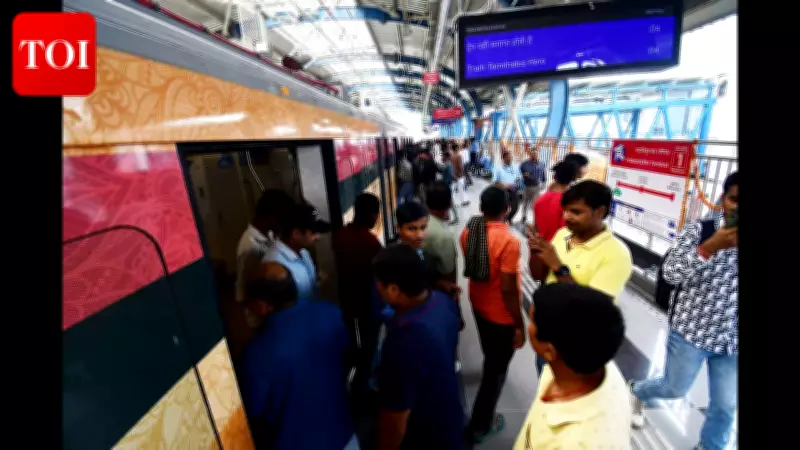
Patna Metro Achieves Major Milestone with Successful Trial Run on Priority Corridor
In a significant advancement for urban transportation infrastructure, the Patna Metro Rail Corporation Limited (PMRC) announced the successful completion of trial runs on the remaining portion of its priority corridor this Thursday. This achievement marks a crucial step forward in the city's ambitious metro rail development project, bringing enhanced connectivity closer to reality for thousands of daily commuters.
Technical Testing and Integration Details
Conducted under the expert supervision of engineers from the Delhi Metro Rail Corporation Limited (DMRC), the comprehensive trial covered the newly constructed 2.9-kilometer elevated stretch between Khemnichak and Malahi Pakri stations. This section has now been seamlessly integrated with the already operational stretch from Bhootnath to the Patliputra Inter-State Bus Terminal (ISBT), creating a continuous elevated corridor.
The testing was performed on the elevated portion of Corridor II between Bhootnath and Malahi Pakri stations, which forms a vital segment of the Patna Metro's Blue Line. During the exercise, metro trains were operated repeatedly to rigorously assess multiple critical systems including:

- Speed and acceleration capabilities
- Braking systems and emergency protocols
- Signaling and communication networks
- Overhead electrical equipment performance
- Overall operational readiness and safety standards
Engineers and technical officials conducted detailed safety inspections and comprehensive evaluations to ensure full compliance with national operational standards and passenger safety requirements.
Operational Impact and Commuter Benefits
According to PMRC officials, the successful completion of these trial runs brings the metro system significantly closer to commencing commercial services on the extended stretch. This expansion is expected to deliver substantial benefits to Patna's transportation network, including:
- Reduced daily travel times for thousands of commuters
- Decreased traffic congestion along major arterial roads
- Enhanced connectivity between key urban areas
- Improved reliability of public transportation options
Critical systems underwent thorough testing during the trials, with particular focus on train performance metrics, electrification stability, and seamless integration between new and existing infrastructure components.
Preparatory Work and Timeline
The trial runs followed extensive preparatory work that included a successful electrical inspection conducted on February 14, 2026, and a comprehensive fire safety check at Malahi Pakri station completed on February 18, 2026. All civil, structural, electrical, and ancillary works at the new stations have been finalized, confirming operational readiness for passenger services.
To facilitate the uninterrupted trial operations, regular passenger services on the existing operational stretch between Patliputra ISBT and Bhootnath were temporarily suspended on Thursday. This allowed engineers to conduct thorough assessments without operational interference. Normal services resumed at Bhootnath, Zero Mile, and ISBT stations beginning February 27.
Future Operational Plans
Engineers confirmed that the remaining two stations of the priority corridor—Khemnichak and Malahi Pakri—are scheduled to become operational following the Holi festival. Once activated, this will make the entire 6.6-kilometer elevated priority section of the Blue Line fully functional, comprising five strategically located stations.
Currently, the operational segment spans approximately 3.6 kilometers from ISBT through Zero Mile to Bhootnath. This stretch has been serving commuters since October 2025 and has already demonstrated positive impacts by reducing congestion along key routes including Bypass Road and Kankarbagh areas.
Strategic Station Design and Network Expansion
Khemnichak station has been designed as a crucial interchange facility that will connect Corridor I (East-West, Red Line) with Corridor II (North-South, Blue Line). Featuring a sophisticated multi-level layout, this station will facilitate smooth passenger transfers between the two major corridors, enhancing network efficiency and user convenience.

The complete Corridor II extends 14.5 kilometers with 12 stations in total—five elevated and seven underground. This comprehensive route will eventually link Patliputra ISBT to Rajendra Nagar, passing through major urban centers including Patna Junction, Gandhi Maidan, PMCH, Patna University, and Moin-ul-Haq Stadium. While the elevated sections near completion, the underground segment remains under active construction with full completion targeted for late 2026.
This development represents a transformative moment for Patna's urban infrastructure, promising to reshape daily commuting patterns while supporting the city's continued growth and modernization efforts. The successful trial runs demonstrate significant progress toward creating a comprehensive, efficient, and sustainable metro rail network for Bihar's capital city.