

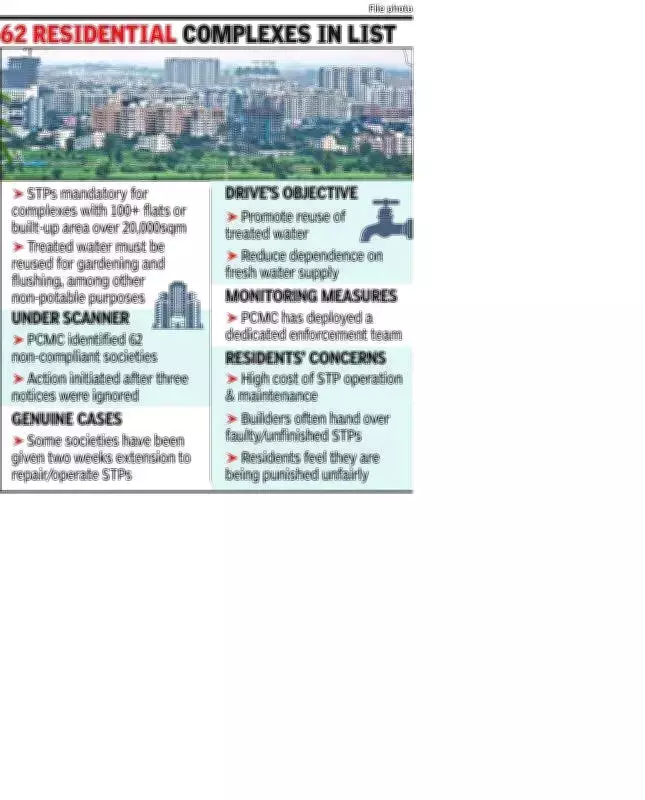
The Pimpri Chinchwad Municipal Corporation (PCMC) has taken stringent action against housing societies that have failed to comply with sewage treatment regulations. This month, the civic body cut off water supply to 24 housing societies for not running their sewage treatment plants (STPs) despite receiving multiple notices. Additionally, 16 housing complexes have been penalized with a fine of Rs 10,000 each for discharging untreated wastewater into stormwater channels.
Regulatory Mandate and Enforcement
According to civic regulations, residential complexes with more than 100 flats or a built-up area exceeding 20,000 square meters are required to install STPs, treat sewage within the premises, and reuse the treated water for non-potable purposes such as gardening and flushing. The PCMC has warned that more housing societies could face similar punitive measures if they fail to adhere to these rules.
Yogesh Alhat, executive engineer of PCMC's environment department, stated that a list of 62 defaulting societies was prepared last month after they ignored three notices. "Following this, we began disconnecting water supply as a punitive measure. More societies could face similar action in the coming days," he said. Fines were also imposed with each notice issued to encourage compliance.

Grace Period and Monitoring
Civic officials revealed that some societies had requested additional time to repair and restart their STPs. "In genuine cases, extensions of about two weeks have been granted to ensure compliance," an official said. The effective reuse of treated water is expected to reduce dependence on fresh water supply, making more water available for other residents. The PCMC has deployed a dedicated team to monitor compliance and enforce the rules.
Government Establishments Under Scrutiny
The enforcement drive has extended beyond private housing complexes to include government establishments. The Pune Metropolitan Region Development Authority (PMRDA) headquarters in Akurdi has also been served notices for a non-functional STP. PCMC officials recently visited the premises to disconnect the water supply after alleged non-compliance, but PMRDA requested additional time, claiming that repairs had been completed and trial runs were underway.
Criticism from Housing Societies
Housing society representatives have criticized the civic body's actions, arguing that residential complexes are being unfairly targeted. Sachin Londhe, a member of the Pimpri Chinchwad Cooperative Housing Societies Federation, highlighted the financial burden on residents. "The cost of operating STPs is high. In many cases, builders have not handed over fully functional systems to societies despite receiving completion certificates from PCMC. Residents are being penalized for issues beyond their control," he said.
Londhe also questioned the corporation's own compliance, alleging that untreated sewage was being discharged from PCMC's treatment facility in Pimple Nilakh. "If the municipal corporation's own STPs are not functioning properly, who will hold them accountable?" he asked.
The PCMC's actions underscore the growing emphasis on wastewater management and environmental compliance in urban areas. As the civic body continues its crackdown, housing societies are urged to ensure their STPs are operational to avoid water supply disconnection and fines.






