

PM's Economic Advisory Council Advocates for Stable Bureaucratic Tenures to Strengthen Urban Governance
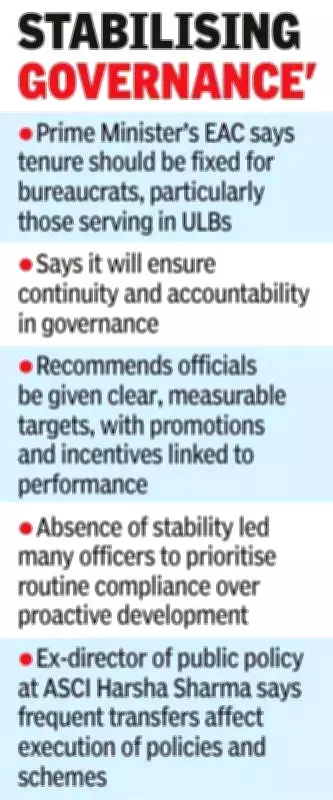
In a significant move to address governance challenges, the Prime Minister's Economic Advisory Council has proposed a mandatory minimum tenure of three years for IAS and IPS officers, particularly those serving in urban local bodies. This recommendation aims to curb the disruptive practice of frequent transfers that undermine policy continuity and administrative accountability.
Structural Imbalance in Urban Administration
The council's report, titled 'India's Hidden Urbanisation & Its Policy Implications', highlights a critical structural issue in city governance. While mayors typically occupy ceremonial positions, real decision-making authority rests with appointed bureaucrats such as municipal commissioners. However, the constant rotation of these officials through transfers creates fragmented tenures that weaken implementation of long-term development initiatives.
"There is a long-standing issue regarding the need for IAS officers to be given a minimum tenure of three years," emphasized Harsha Sharma, former director of public policy at the Administrative Staff College of India and current director of Giri Institute of Development Studies in Lucknow. "Transferring officials within six months across states has become common practice, yet these officers need at least six months just to understand local issues."

Performance-Based Incentives and Clear Targets
The Economic Advisory Council's comprehensive recommendations include:
- Establishing clear, measurable performance targets for bureaucrats
- Linking promotions and incentives directly to achievement of these targets
- Exploring alternative administrative arrangements when urban local body elections face delays
- Formally recognizing rapidly urbanizing areas through establishment or upgrading of urban local bodies
Sharma, who has collaborated extensively with the Prime Minister's Office in selecting recipients of the SOCH awards for excellence in public governance, noted that frequent transfers prevent officers from thinking strategically. "As key executors of policies, they often fail to think long-term due to frequent changes and transfers," she explained.
Historical Context and Implementation Challenges
Despite a 2014 reform proposal suggesting a minimum two-year tenure for bureaucrats, implementation has remained limited. The absence of stable tenures, combined with inadequate performance-based incentives, has created an environment where officers prioritize routine compliance over proactive development initiatives.
The council's report identifies several consequences of this instability:
- Bureaucrats avoid decisions extending beyond their mandated duties due to accountability risks
- Limited rewards for initiative-taking discourage innovative governance approaches
- Policy discontinuity hampers long-term urban development projects
Roadmap for Urban Governance Reform
To address these systemic issues, the Economic Advisory Council proposes a multi-pronged approach:
Aligning incentives with outcomes to encourage more engaged and responsible administration represents a cornerstone of the proposed reforms. The council emphasizes that without proper motivation structures, even stable tenures may not yield optimal governance results.
The report also recommends elevating advanced town panchayats and municipalities into full-fledged municipal corporations based on current population data and infrastructure needs. This formal recognition of urbanization patterns would better equip local bodies to manage migration flows and economic growth.
Furthermore, the council stresses the importance of strengthening urban governance by linking access to central development schemes with specific reforms in urban local bodies, including the timely conduct of elections and implementation of performance measurement systems.
By addressing both tenure stability and incentive structures, the Economic Advisory Council's recommendations aim to create a more responsive, accountable, and effective bureaucratic system capable of supporting India's rapid urbanization and development goals.






