

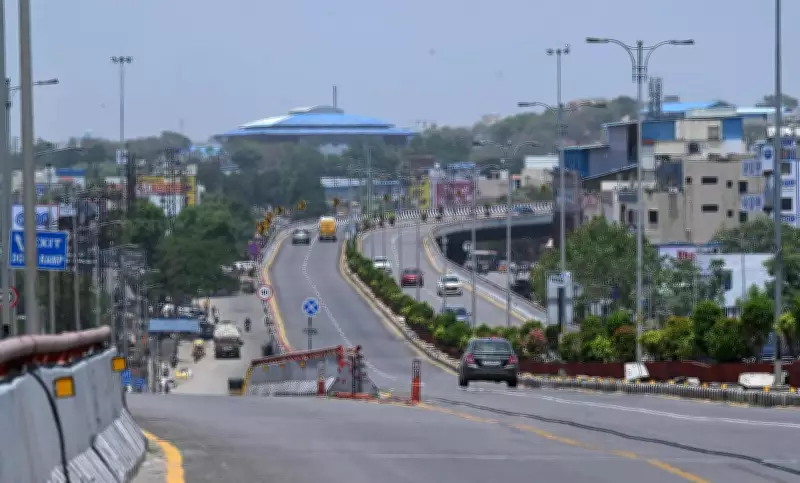
Hyderabad: The 11.5-km-long PVNR Expressway, one of the longest flyovers in the country, continues to grapple with inadequate safety measures, even as accidents on the stretch have more than doubled over the past year, from five in 2024 to 13 in 2025.
A ground visit by TOI revealed that several critical safety measures recommended by the Central Road Research Institute (CRRI) during its safety audit of the corridor are either missing or poorly maintained. The Hyderabad Metropolitan Development Authority (HMDA) has reportedly failed to implement measures such as adequate rumble strips, surveillance cameras, and road markings along the expressway.
CRRI Recommendations Overlooked
“We submitted several recommendations to HMDA as early as 2010 to improve safety on the PVNR Expressway. These included transverse bar markings to alert drivers to upcoming hazards, crash barriers at sharp curves, crash-absorbing devices, and glare cutters. However, when I travelled on the flyover again two years ago, I found little evidence of improvement or implementation of these critical safety measures,” said K Ravinder, chief scientist at CRRI.

Speeding and Lack of Warning Signs
Adding to the concerns are outdated speed-limit signboards and a lack of warning signs around accident hotspots and other critical sections. During the visit, several vehicles were found travelling at speeds exceeding 100 kmph, against the prescribed limit of 60 kmph. Despite the narrow carriageway, motorists were also seen overtaking at high speeds.
In fact, the absence of crash barriers along sections of the expressway has emerged as another major safety concern. With medians measuring barely a foot in height across the corridor, vehicles can easily cross into the opposite carriageway when drivers lose control.
Recent Accident Highlights Dangers
The danger was evident in an accident last month in which two people were injured after a car overturned on the PVNR Expressway. The vehicle, carrying five occupants, was travelling from Rajiv Gandhi International Airport towards Mehdipatnam when the driver lost control and crashed into the divider. The impact caused the car to flip over and fall onto the opposite side of the road.
Police Cite Lack of CCTV Cameras
Police officials admitted that the absence of CCTV cameras on the flyover often hampers accident investigations and makes it difficult to determine responsibility. “We have written to HMDA seeking installation of surveillance cameras at strategic locations covering critical stretches of the expressway. In accidents occurring on city roads, we generally rely on CCTV footage or eyewitness accounts to ascertain the cause. On the PVNR Expressway, both are often unavailable, making investigations challenging,” said Rahul Hegde, DCP III (Traffic), Hyderabad City Police.
Officials added that accidents on the expressway frequently lead to massive traffic congestion, requiring recovery vehicles to be rushed to the spot to clear stranded vehicles and restore traffic movement.
Design Limitations and Safety Interventions Needed
Experts point out that the expressway was originally designed for operating speeds of around 50-60 kmph, making excessive speeding a major safety concern. At present, only one traffic policeman equipped with a speed laser gun is deployed near the Shamshabad airport end of the expressway, leaving much of the corridor without active speed monitoring.
“There are several S-curves on the flyover, and it is practically impossible to alter the design, alignment or structure at this stage. However, safety interventions such as proper road markings, warning signboards at black spots and curves, and CCTV surveillance are essential, but many of these measures are missing,” said Vinod Kanumala, expert and co-founder of Indian Federation of Road Safety.
Multiple representations were submitted to the authorities during 2015-16 seeking installation of CCTV cameras on the expressway, but no action has been taken. Some of the curves are particularly dangerous and require lower speed limits of around 40 kmph, he said. “Yet motorists routinely exceed even those limits. Strong enforcement and stricter penalties are necessary.”

HMDA Announces New Safety Measures
Meanwhile, officials say work on several safety measures has already begun on the PVNR Expressway, including the installation of Automatic Number Plate Recognition (ANPR) cameras to curb accidents caused by overspeeding. Recently, HMDA also engaged IIT Hyderabad to carry out a safety audit.
“More than 20 ANPR cameras will be installed at critical stretches of the corridor. Once operational, the system will automatically capture the registration numbers of vehicles violating speed limits and other traffic rules, enabling stricter enforcement. We are also replacing outdated signboards and carrying out fresh road markings across the expressway. All these safety interventions are expected to be completed within the next three months,” said a senior official in HMDA.





