

Sanitation Audit Exposes Critical Gaps in Gurgaon and Faridabad Waste Management
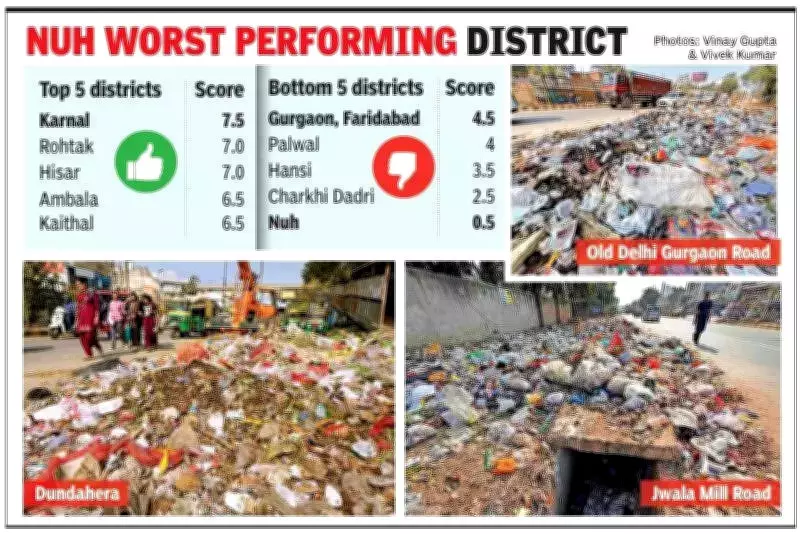
A rapid sanitation audit conducted by the Chief Minister's Good Governance Associates (CMGGA) has uncovered significant lapses in cleanliness and waste management systems across Haryana's urban centers. The assessment, which evaluated 23 districts, placed two major cities—Gurgaon and Faridabad—in the concerning 'needs attention' category due to their poor performance.
Disturbing Scores Reveal Systemic Issues
The comprehensive survey, conducted on February 11–12 ahead of the upcoming Swachh Survekshan evaluation, assessed districts on a scale of 0 to 10 across eight critical sanitation parameters. Gurgaon and Faridabad both scored a meager 4.5 out of 10, placing them among the poorest performers in the state.
The rating system categorized districts as follows:

- 'Needs Attention': Scores between 0 and 4.5
- 'Average': Scores between 5 and 6
- 'Good': Scores between 6.5 and 10
Karnal emerged as the top performer with an impressive score of 7.5, earning a 'good' rating. Rohtak and Hisar followed closely with 7 points each, also securing 'good' classifications. Several other districts including Ambala, Kaithal, Panchkula, and Bhiwani scored 6.5, maintaining their positions in the 'good' category.
Bottom Performers Highlight Stark Contrasts
At the opposite end of the spectrum, the audit revealed alarming deficiencies. Charkhi Dadri scored only 2.5, while Nuh ranked last with a stark 0.5—the lowest score recorded in the entire assessment.
The eight parameters evaluated during the audit included:
- Visible cleanliness in public spaces
- Door-to-door waste collection and segregation systems
- Waste processing and disposal mechanisms
- Access and usage of public toilets
- Drainage management infrastructure
- Sanitation worker welfare provisions
- Information, education, and communication (IEC) awareness programs
- Urban local body (ULB) leadership and monitoring capabilities
Severe Personnel Shortages Cripple Operations
The report highlighted a critical personnel shortage in Gurgaon's sanitation administration, representing one of the steepest gaps recorded statewide. Currently, only 41 of the 83 sanctioned supervisory posts are filled, resulting in a 51% vacancy rate that has left essential roles in inspection, monitoring, and enforcement vacant.
CMGGA conducted human resource mapping across various positions including:
- Chief sanitation inspectors
- Sanitation inspectors
- Assistant sanitation inspectors
- Supervisors and darogas
In Faridabad, 90 posts are sanctioned with 66 currently filled. Statewide, the average shortfall stands at 30%, but the report notes that even larger municipal corporations—expected to have stronger administrative capacity—face significant deficits.
Performance Variations Across Districts
The audit revealed striking variations in staffing and performance across different districts:
- Karnal (top performer): Only 19 sanctioned posts but exceeded this with 62 positions filled
- Palwal: 8 sanctioned posts with 10 filled
- Rewari: All 10 sanctioned posts filled
- Panchkula: 77 posts sanctioned with 54 filled
Systemic Failures and Paper Compliance
The internal findings were unusually candid, directly attributing sanitation failures to manpower shortages that cause weak enforcement and "unchecked field activities." The report also flagged widespread "paper compliance"—ward committees, waste-free declarations, and processing systems that formally exist on documentation but remain non-functional in practice.
Compounding these issues, several districts lack ward-wise vehicle mapping and rely on unscientific resource estimates. The report emphasized that payments to private waste-collection vendors should be based on actual deployment to curb inflated billing and absenteeism.

Corrective Action Plan and Municipal Response
MCG commissioner Pradeep Dahiya responded to the findings, stating, "We plan to focus on all parameters considered in the survey. Moreover, we established a sanitation monitoring cell today (Friday) to further strengthen our performance."
The CMGGA has outlined a comprehensive four-week corrective plan for urban local bodies, focusing on:
- Streamlining door-to-door waste collection by April 10
- Conducting ward reviews with the Chief Minister by March 20
- Implementing a statewide drain-cleaning drive from April 15–30
- Addressing staffing proposals and personnel shortages
The survey also revealed limited awareness among officials about the assessment toolkit, highlighting the need for internal awareness campaigns and orientation exercises to improve future performance.
Broader Governance Context
Launched in 2016, the CMGGA initiative aims to improve governance across Haryana by ensuring high-priority citizen-centric schemes are effectively implemented at the grassroots level. This solid waste management feedback survey represents one of several mechanisms through which the program assesses and addresses critical infrastructure and service delivery gaps across the state's urban centers.





