

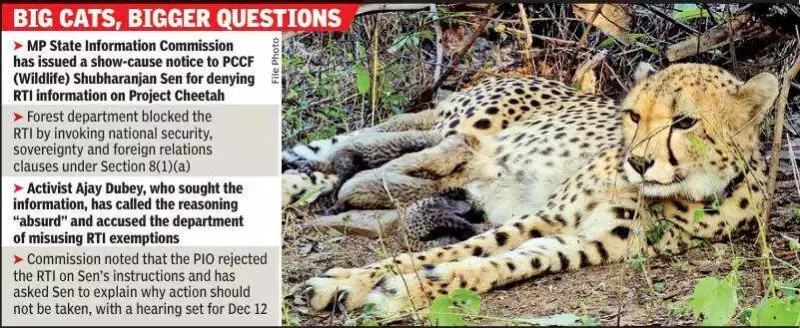
The Madhya Pradesh State Information Commission has taken a strong stance against the state's forest department for refusing to share details about the high-profile Project Cheetah. The commission has issued a formal show-cause notice to the Chief Wildlife Warden, Shubharanjan Sen, demanding an explanation for why information was withheld from a Right to Information (RTI) applicant by invoking clauses related to national security and sovereignty.
The Notice and Potential Consequences
Chief Information Commissioner Vijay Yadav has directed PCCF (Wildlife) Shubharanjan Sen to personally appear before the commission on December 12, 2024. The notice explicitly warns of possible legal and departmental actions, including a statutory fine and a formal inquiry, if a satisfactory explanation is not provided. The commission's action stems from a complaint filed by activist Ajay Dubey, who alleged that Sen misused the RTI Act's exemption clauses to block the release of public information.
Root of the Controversy: An RTI Request Denied
The dispute began in July 2024, when wildlife and RTI activist Ajay Dubey filed an application seeking information on the management of cheetahs in Madhya Pradesh. His request covered correspondence related to the Kuno Wildlife Sanctuary in Sheopur and the Gandhi Sagar Wildlife Sanctuary in Mandsaur—the current and proposed homes for the reintroduced big cats.

The state forest department's Public Information Officer rejected the request, invoking Section 8(1)(a) of the RTI Act. This section allows information to be withheld if its disclosure could prejudicially affect India's sovereignty, integrity, national security, strategic interests, or foreign relations.
Amplifying the Dispute: The NTCA Clarification
The controversy deepened when the National Tiger Conservation Authority (NTCA) sought a clarification from the MP forest department regarding the RTI denial. In its written response to the NTCA, the department doubled down on its position. It argued that Project Cheetah involves sensitive international collaborations with nations like South Africa, Kenya, and Namibia, and that sharing details could "jeopardize these relationships and the project's integrity."
A letter from Public Information Officer Saurav Kumar Kabra to the NTCA stated that the disclosure might harm India's sovereignty and its relations with foreign states. It emphasized that the project is a "critical experimental scheme" approved by the Supreme Court in January 2020 and involves Memoranda of Understanding with partner nations and periodic guidance from foreign experts.
Activist Ajay Dubey has dismissed the department's justification as "absurd" and a blatant misuse of national security clauses. "I don't know when MP received cheetahs from Kenya," he remarked, highlighting factual inaccuracies in the defence. He has filed an appeal against the RTI denial, which led to the State Information Commission's intervention.
The commission's notice points out that the PIO was expected to provide the information but acted on instructions from Sen to block it entirely. The final course of action will be determined based on Sen's response during the December 12 hearing. This case puts a spotlight on the balance between transparency in government projects and claims of strategic sensitivity.






