

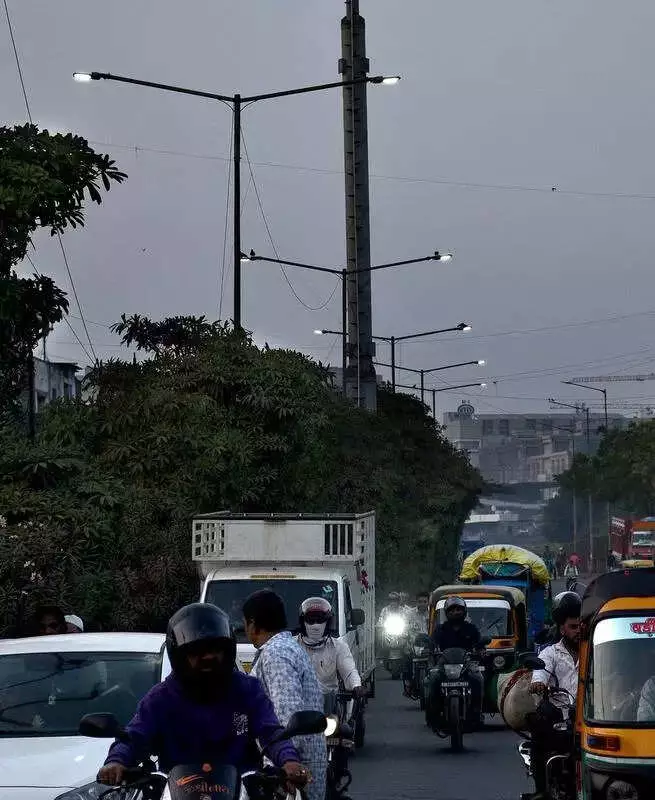
A group of dedicated volunteers in Surat has raised serious concerns over alleged electricity wastage by the city's municipal corporation. Their investigation found that streetlights at numerous locations remain switched on for up to two hours beyond their scheduled time, contradicting the civic body's public push for renewable energy and conservation.
Systematic Monitoring Reveals Persistent Problem
The issue came to light when volunteers, during their travels across the diamond city, noticed streetlights illuminated well after sunrise. Intrigued, they began a systematic monitoring exercise. They revisited specific spots for two to three consecutive days to verify the timing discrepancies. The group documented their findings with photographs and even created a dedicated social media page to gather similar updates from other residents across Surat.
Divyesh Kumawat, a volunteer associated with the group, revealed the scale of their efforts. "So far, we have filed more than 700 complaints. Sometimes the problem repeats at the same location, and sometimes at different places. This sends a wrong message to society," he stated. Another volunteer, Jignesh Angiwala, expressed frustration over the lack of permanent resolution despite repeated complaints and several Right to Information (RTI) applications. "It is unfortunate that public money is being wasted every year due to electricity wastage instead of being spent on better public works," Angiwala said.

SMC's Response and Infrastructure Challenges
When confronted with the allegations, officials from the Surat Municipal Corporation (SMC) downplayed the issue as not being widespread. They provided explanations for the anomalies, stating that in some areas, lights are deliberately kept on during daytime for repair or testing work. Officials also acknowledged potential lapses due to faults in the automated machinery that controls the switching operations.
According to data shared by the SMC, Surat has approximately 1.73 lakh (173,000) streetlights. Of these, nearly 70% are operated through electronic timers, while the remaining 30% still rely on non-electronic timers. The operation of these lights is managed at the zonal level, with the electrical department overseeing infrastructure development. Timer settings are adjusted monthly, with minor variations to account for changing daylight hours.
An SMC official also hinted at possible vandalism, suggesting that miscreants might be damaging the light-operating systems in some locations. "Our teams regularly monitor the streetlights and take corrective action whenever timing issues are noticed. Given the wide network, issues do arise occasionally, but we are working to further improve the infrastructure," the official assured.
A Question of Accountability and Conservation
The volunteers' campaign highlights a significant gap between policy and implementation. While the SMC promotes renewable energy initiatives, this recurring wastage of conventional electricity undermines those efforts and represents a drain on public funds. The group's method of using official grievance portals and RTI applications shows a structured, citizen-led approach to accountability.
The core conflict remains: citizens are taking proactive steps to audit public utility management, while the civic body attributes the problems to technical glitches, maintenance needs, and occasional sabotage. With hundreds of complaints logged, the demand is for a more robust and fault-tolerant system to ensure that Surat's street lighting is both efficient and cost-effective, aligning with the city's modern and sustainable aspirations.






