Viral Train Garbage Video Sparks Intense Debate on Civic Sense and Parenting in India
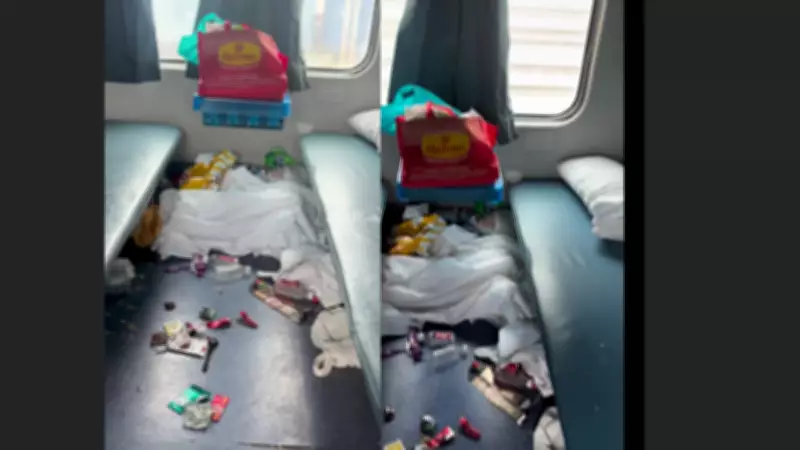
A disturbing video capturing a train coach completely strewn with garbage has gone viral across social media platforms, triggering a widespread and heated debate about civic behavior, parenting, and public responsibility in contemporary India. The footage, filmed inside a train compartment, presents a dirty and chaotic scene littered with food wrappers, plastic bottles, used spoons, and bedsheets scattered haphazardly across the floor.
Passenger Confronts Students and Highlights Shared Responsibility
The individual who recorded the video claimed that the extensive mess was left behind by a group of Class 10 students traveling to Manali for a tour, although the students themselves are not visible in the footage. In the video, the passenger can be heard passionately urging for better civic sense among citizens. Speaking in Hindi, he describes confronting the students and directly asking them to clean up the space they had dirtied.
"People talk about civic sense. There are Class 10 students here going on a Manali tour. I told them to pick up the trash. In fact, I also picked up some garbage in front of them," he states clearly in the clip. He proceeds to emphasize that public spaces inherently require shared responsibility and collective care from all users.

"I told them this is public property, and they should not behave like this. These are the same people who will later post on social media. They should at least have this basic knowledge," he adds with evident frustration. The passenger also noted that the group appeared to be teenagers, likely around 16 or 17 years old, but he firmly emphasized that age should never excuse such irresponsible and disrespectful behavior towards public property.
Social Media Reactions: Parenting, Schools, and Systemic Failures Questioned
The video rapidly gained significant traction online, with users offering sharply divided and passionate opinions on who ultimately bears responsibility for such recurring incidents. Numerous users directly associated this behavior with upbringing and parental guidance, arguing that one's conduct concerning cleanliness and public spaces is profoundly influenced by familial values and examples set during childhood.
One user's comment strongly implied that children tend to imitate what they observe while growing up, including how adults behave around shared communal spaces and their treatment of sanitation workers. Others pointed critically to the role of educational institutions, asserting that schools must do far more to systematically instil civic values and ethical responsibility alongside traditional academic learning.
According to some commentators, since children spend a substantial portion of their formative years in school environments, structured lessons and practical training on public responsibility, hygiene, and respect for shared property should be emphasized within the curriculum. Simultaneously, some voices stressed that the issue extends beyond individual failings, calling for comprehensive systemic solutions and policy interventions to actively discourage littering and promote cleanliness.
Calls for Stricter Measures and Practical Solutions on Trains
Among the various ideas and suggestions being widely discussed online is the implementation of a refundable cleanliness deposit directly linked to train tickets. One user proposed that passengers could potentially get this deposit back by submitting a photograph of their clean berth through an official railway application, thereby creating a direct mechanism for accountability.
Other practical suggestions included significantly increasing the availability and visibility of dustbins inside train coaches, along with stricter monitoring by railway staff and more substantial penalties for those caught littering. These proposals aim to address the problem through both incentive-based and enforcement-based approaches.

A Recurring and Persistent National Issue
This incident has once again glaringly highlighted the persistent and challenging problem of ensuring consistent cleanliness within India's vast public transport facilities. While Indian trains carry millions of passengers daily across the nation, individual responsibility remains a critical and often lacking factor in maintaining basic hygiene and order.
This is certainly not the first viral video to expose such issues within the railway system. However, as this particular video continues to circulate widely, it has powerfully reignited a familiar yet crucial national conversation: whether civic sense is primarily taught at home and in schools, enforced through regulations, or simply practiced through personal choice, and who ultimately bears the fundamental responsibility for keeping our shared public spaces clean and respectable for all citizens.