In a significant boost to green public transportation, Andhra Pradesh has been sanctioned a fleet of 750 electric buses by the central government. The allocation is a key part of the national drive towards clean and sustainable urban mobility.
Focus on Visakhapatnam and Faster Deployment
Out of the total allocation for the state, 150 electric buses are specifically designated for the port city of Visakhapatnam. To ensure these zero-emission vehicles hit the roads swiftly, the Andhra Pradesh State Road Transport Corporation (APSRTC) has already moved forward. The corporation has issued a formal letter of award to the chosen operator, a critical step that accelerates the deployment process across the state.
Part of a Larger National Green Initiative
This distribution of buses falls under the ambitious PM-eBus Sewa scheme, administered by the Union Ministry of Housing and Urban Affairs. The scheme is a cornerstone of India's strategy to electrify public transport systems nationwide. The successful implementation follows a major achievement by Convergence Energy Services Limited (CESL), a subsidiary of Energy Efficiency Services Limited (EESL).

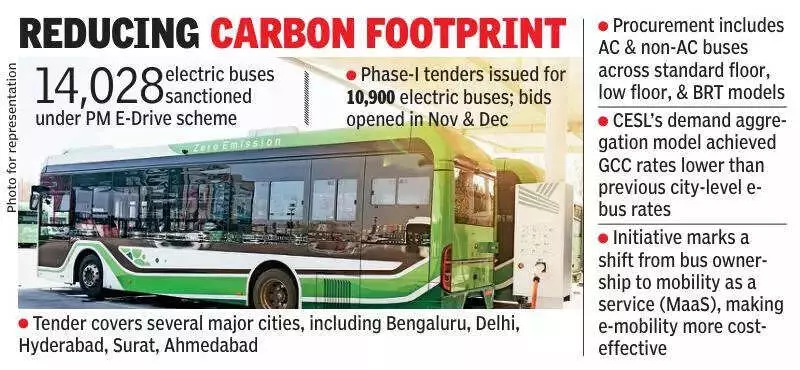
CESL, acting as the central government's nominated agency, recently concluded India's largest mega tender for 10,900 electric buses under the related PM E-Drive scheme. Buoyed by this success, CESL estimates that this massive initiative will lead to a staggering reduction of 4 million tonnes of carbon dioxide (CO₂) emissions. The project is set to replace thousands of diesel buses, promising substantial improvements in urban air quality, lower noise pollution, and better living standards in five major Indian cities.
Leadership and Broader Impact
Akhilesh Kumar Dixit, the CEO of both CESL and EESL, highlighted the collaborative effort behind the project. He credited the support from the Union Ministries of Heavy Industries and Power for enabling effective demand aggregation and ensuring a transparent, competitive tendering process. Dixit emphasized that such initiatives are expected to drastically reduce India's carbon footprint while modernizing public transport. They offer a cleaner, quieter, and more cost-effective alternative to traditional fossil fuel-based vehicles.
In its official report to the Union Government, CESL underscored the pivotal role of the PM E-Drive scheme. The scheme, steered by the Ministry of Heavy Industries, is projected to be instrumental in promoting sustainable economic development and is a crucial step towards achieving India's net-zero emissions target by 2070.