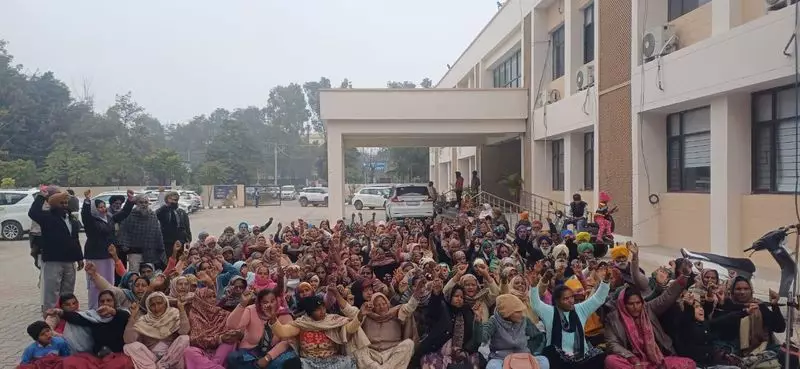
Hundreds of Anganwadi workers and helpers, backed by the Centre of Indian Trade Unions (CITU), staged a significant protest in Chandigarh on Thursday, voicing strong opposition to the central government's newly proposed rural job scheme. The demonstrators gathered at the Matka Chowk, directing their ire towards what they perceive as a flawed plan that threatens their livelihoods and the foundational principles of employment guarantee.
Core of the Discontent: The "Agniveer"-Style Scheme
The protest was specifically aimed at the Union government's recent announcement to launch a new scheme under the Mahatma Gandhi National Rural Employment Guarantee Act (MNREGA) framework. The workers, organized under the CITU-affiliated Anganwadi Workers and Helpers Union, Chandigarh, drew a parallel between this new initiative and the controversial Agnipath scheme for armed forces recruitment. They fear the rural job plan will adopt a similar short-term, contractual model, stripping away job security and guaranteed wages.
Union president Hargobind Kaur led the charge, articulating the primary concerns. She stated that the proposed scheme appears to be designed to dismantle the existing guarantee of 100 days of work per year at assured wages. Instead, it might introduce a system where workers are hired on a temporary basis for specific projects, leaving them in a perpetual state of uncertainty and financial instability.

Key Demands of the Protesting Workers
The protesters presented a charter of demands, extending beyond their criticism of the new rural job plan. Their core grievances highlight long-standing issues within the Anganwadi system. The union's demands include:
- Immediate withdrawal of the proposed new rural employment scheme.
- Recognition of Anganwadi workers and helpers as government employees with all associated benefits and protections.
- Implementation of a minimum monthly honorarium of Rs 26,000 for workers and Rs 20,000 for helpers, a significant increase from current payments.
- Provision of a comprehensive pension scheme to ensure financial security after retirement.
Hargobind Kaur emphasized the critical role these workers play as the "backbone of the Integrated Child Development Services (ICDS) scheme," delivering essential nutrition and pre-school education at the grassroots level. Despite their crucial contribution to public health and early childhood education, they continue to be classified as "volunteers," denying them the status and remuneration of regular employees.
Broader Implications and Union's Resolve
The protest in Chandigarh is not an isolated event but reflects a growing wave of discontent among frontline scheme workers across the country. The union leaders warned that the proposed changes to MNREGA could set a dangerous precedent, eroding the legal right to work and undermining the social security net for rural households.
The demonstration concluded with the submission of a detailed memorandum outlining their demands to the UT Administration, intended for onward transmission to the President of India. The union has made it clear that this protest is merely the beginning of a sustained agitation. They have threatened to escalate their movement, including plans for a massive march towards the Parliament in New Delhi, if the government proceeds with the new scheme without addressing their fundamental concerns regarding permanent status and guaranteed wages.
This mobilization puts a spotlight on the ongoing tension between the government's policy directions and the demands of a vast, essential workforce that forms the operational core of India's flagship social welfare programs. The outcome of this confrontation could have significant implications for the future of rural employment and the working conditions of millions of scheme workers nationwide.