Andhra Pradesh Government Announces Free Electricity Scheme for Weavers
In a major policy intervention aimed at revitalizing the traditional handloom sector, the Andhra Pradesh government has announced it will roll out a free electricity scheme for weavers starting from April 1. This initiative is designed to provide substantial financial relief and boost the rural economy by directly supporting the artisans who form its backbone.
Direct Benefits to Over 1.03 Lakh Weaving Families
The decision is expected to directly benefit more than 1.03 lakh weaving families, significantly cutting production costs and improving household incomes. Special Chief Secretary (Handlooms & Textiles) RP Sisodia emphasized that this move represents a decisive shift towards offering sustained financial security to weavers.
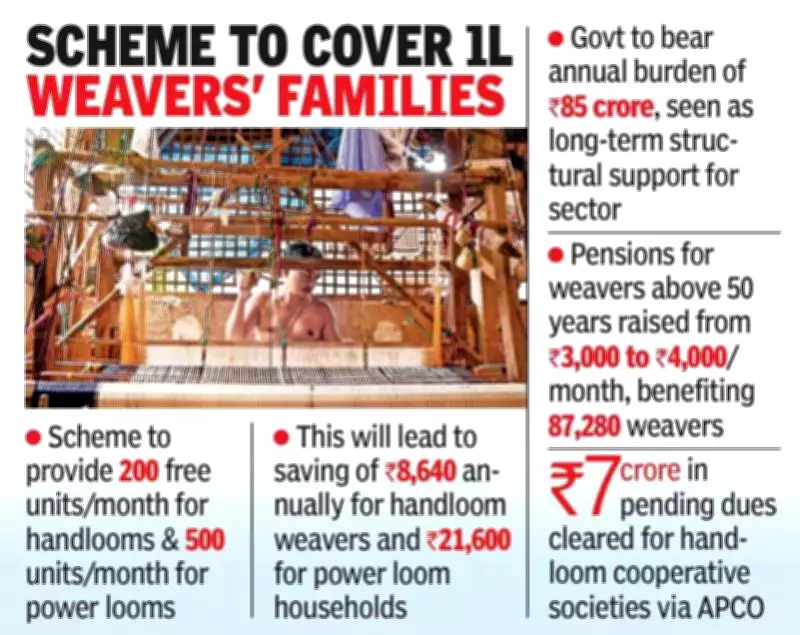
"This is not merely a subsidy but a structural support measure," Sisodia stated. He detailed that the government will provide 200 free units per month for handlooms and 500 free units per month for power looms. This translates into annual savings of ₹8,640 for handloom weavers and ₹21,600 for power loom weavers, directly enhancing their economic stability.

Scheme Coverage and Fiscal Impact
The scheme will cover 93,000 handloom families and 10,534 power loom households, bringing the total beneficiaries to 1,03,534. Acknowledging the fiscal implications, Sisodia noted that the government will bear an annual burden of over ₹85 crore. However, he stressed that revitalizing the handloom sector requires long-term public investment rather than short-term measures.
Parallel Welfare Measures for Weavers
In addition to the free electricity scheme, the government has implemented several other welfare initiatives:
- Pensions for weavers aged above 50 years have been increased to ₹4,000 per month, benefiting 87,280 weavers. This enhancement from ₹3,000 ensures an additional ₹12,000 annually per weaver, strengthening income security beyond their active working years.
- The government cleared ₹7 crore in pending dues to handloom cooperative societies through APCO in the last two months.
- Under the first tranche of thrift fund assistance this year, ₹1.67 crore has been sanctioned.
- A 15 percent yarn subsidy has been extended through NHDC, and processing charges have been enhanced to ensure fair compensation for weavers.
Ensuring Sustainable Livelihoods and Market Access
Sisodia highlighted that the government is committed to ensuring 365 days of work for weavers through strategic partnerships. "Tie-ups with Co-optex, Tata Taneira, and Aditya Birla have opened stable market channels," he said. Furthermore, sales of ready-made garments through APCO and e-commerce platforms are expanding the reach and demand for handloom products, creating more opportunities for artisans.
Infrastructure Development for Long-Term Growth
To support the long-term growth of the handloom sector, significant infrastructure projects are underway:
- A unity mall in Visakhapatnam is being constructed on 5 acres at a cost of ₹172 crore.
- Textile parks are planned at Yemmiganur, Rayadurgam, Mylavaram, and Pamidi, along with a mega textile park at Mangalagiri.
- Mega clusters at Dharmavaram and Pithapuram, besides 10 mini clusters worth ₹10.44 crore, are also in development.
National Recognition and Government Commitment
Handlooms and Textiles Minister S Savita highlighted that Andhra Pradesh has received national acclaim, securing nine ODOP awards, of which four were for handloom products. The state also won a national gold medal for its handloom development initiatives. "The free power scheme was a key commitment made to weavers. The coalition government's objective is to ensure financial stability and a dignified livelihood for the weaving community," the minister affirmed.

This comprehensive approach underscores the government's dedication to not only providing immediate relief but also fostering a sustainable ecosystem for the handloom sector, ensuring its growth and recognition on both state and national levels.