

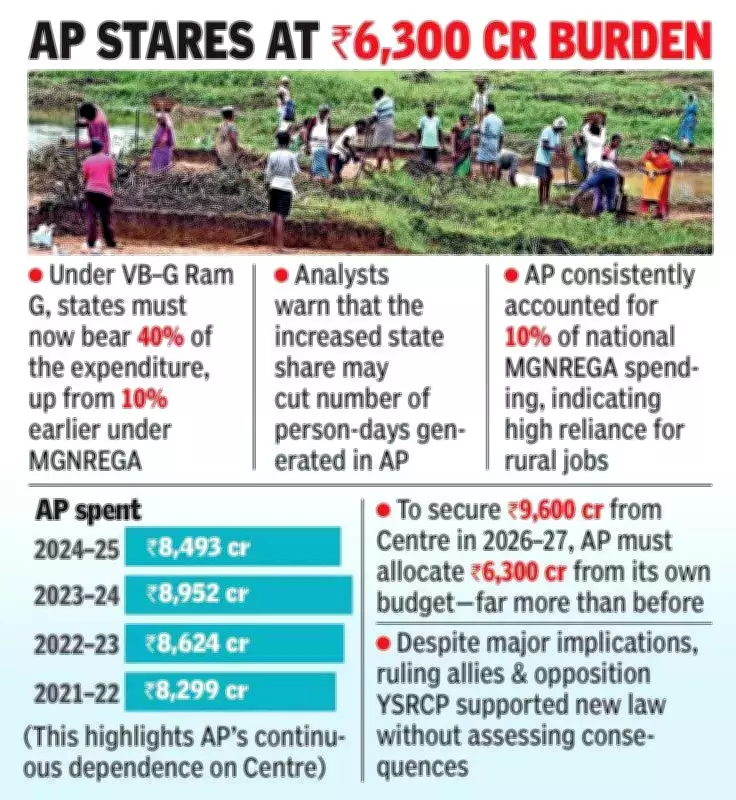
Andhra Pradesh Confronts Massive Financial Burden Under Revised Rural Employment Scheme
Vijayawada: In a development that could significantly impact rural livelihoods, Andhra Pradesh faces a daunting financial challenge under the revamped VB–G Ram G rural employment guarantee programme. Despite substantial increases in central allocations announced in the Union Budget, the state may witness a sharp decline in employment generation due to a major overhaul in funding rules that dramatically increases the financial burden on states.
Drastic Shift in Funding Formula
The revised framework represents a fundamental change in how rural employment schemes are financed. Under the new rules, states are now required to shoulder 40 per cent of the scheme's expenditure, compared to just 10 per cent earlier under the MGNREGA framework. This fourfold increase in state contribution has raised serious concerns among policy analysts and activists who warn that this shift could severely restrict the generation of person-days, particularly in states like Andhra Pradesh that have consistently been among the largest beneficiaries of rural employment programmes.
Andhra Pradesh's Historical Dependence on Rural Employment Schemes
Data from recent years highlights Andhra Pradesh's substantial dependence on these schemes. In 2024–25, against a national expenditure of Rs 1,04,282 crore, the state recorded expenditure of Rs 8,493 crore, maintaining a share of roughly 10 per cent. A similar trend was observed in 2023–24, when AP's expenditure stood at Rs 8,952 crore out of a national total of Rs 1,05,222 crore.

The state's sustained reliance on the programme is further evidenced by expenditure patterns from previous years:
- 2022–23: Rs 8,624 crore
- 2021–22: Rs 8,299 crore
These figures underline how consistently Andhra Pradesh has depended on rural employment programmes to support livelihoods during agricultural lean seasons and economic downturns.
The Rs 6,300 Crore Challenge
Officials note that if Andhra Pradesh were to retain its customary 10 per cent share under VB–G Ram G, the state would need to allocate at least Rs 6,300 crore in the state budget for the next financial year. Buddha Chakradhar, senior researcher at LibTech India, which monitors rural employment schemes, warned that the change could undermine the programme's foundational objective.
"Increasing the state share from 10 per cent to 40 per cent effectively transfers financial risk to fiscally constrained states," he noted. "In Andhra Pradesh, this is likely to result in reduced employment days for the poorest households and slower wage disbursals."
Financial Implications for 2026–27
The national-level budget allocation for the scheme is approximately Rs 96,000 crore. Given that Andhra Pradesh has consistently received around 10% of national allocations over the last three years, the state would be expected to receive about Rs 9,600 crore in 2026–27 under normal circumstances.
However, to secure this Rs 9,600 crore from the central government, the state would now need to provide a matching contribution of roughly Rs 6,300 crore. As analysed by Chakradhar, this would take the total expenditure to around Rs 15,000–16,000 crore, representing the level of spending being implicitly promised under the VB–G Ram G framework.
Political Response and Future Implications
Surprisingly, both ruling allies of the NDA—including TDP, Janasena, and BJP—and the opposition YSRCP welcomed the new law on rural employment guarantee without thoroughly examining its financial consequences. This bipartisan support has raised questions about whether political parties fully comprehend the budgetary implications for the state.
Any reduction in employment opportunities could have far-reaching consequences for rural Andhra Pradesh, potentially impacting household incomes, consumption patterns, and asset creation activities that have traditionally been supported through these employment programmes.

All eyes are now on Andhra Pradesh Finance Minister P Keshav, who will present the state budget on February 14. The allocation he makes for the employment guarantee scheme will reveal how seriously the state government takes this new financial responsibility and what compromises might be necessary in other development areas to meet this substantial burden.





