

Bhopal's Electric Bus Initiative Confronts Pedestrian Safety Hurdles
The state capital of Madhya Pradesh is gearing up to introduce its first fleet of 100 electric buses by mid-2026, a significant step under the PM e-Bus Sewa scheme. This initiative aims to position Bhopal as a flagship city for the state's electric transition, with an additional 95 buses proposed for later phases. Charging depots are nearing completion, and officials anticipate that these new services will serve as clean feeders to the recently inaugurated metro network, enhancing public transportation options.
Pedestrian Safety Concerns Amid Green Mobility Push
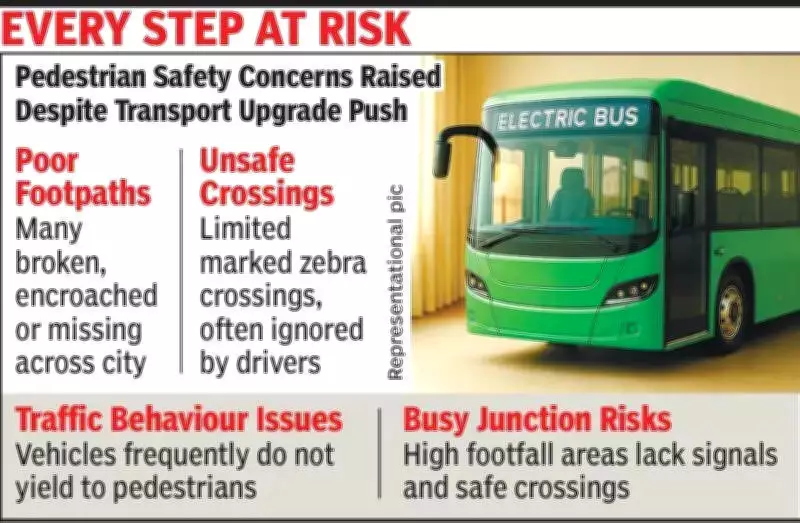
However, transport experts are raising alarms about a more fundamental issue: the city's failure to ensure pedestrians can safely exercise their legal right of way. Rahul Tiwari, a road safety expert and assistant professor in the department of architecture and planning at MANIT, emphasized that while electric buses represent a positive and long-pending development, technology alone will not secure streets. "Unless we redesign intersections, slow down traffic around bus stops, rigorously enforce pedestrians' right of way at crossings, and ensure last-mile connectivity to those stops, people will feel unsafe on foot," he stated.
A 2025 report, conducted after the dismantling of the 'dedicated' BRTS corridor, revealed troubling city conditions. Only a minority of Bhopal's roads feature usable footpaths, with many being broken or encroached upon, forcing pedestrians to walk in live traffic. Safe crossings are scarce, with fewer than two in ten locations offering marked pedestrian crossings, and even at these spots, drivers routinely ignore zebra markings.

Legal Framework and On-Ground Realities
This situation conflicts sharply with India's Rules of the Road Regulations, 1989, which grant pedestrians the right of way at uncontrolled crossings. Courts have reinforced this principle, affirming that drivers must recognize the "first right" of pedestrians on the road, even when individuals cross away from designated zebra lines.
Field studies at busy junctions such as Nehru Nagar and Mata Mandir illustrate the daily risks. Hundreds of pedestrians navigate faded zebra crossings hourly, often without pedestrian signals, while vehicles—including buses—travel at speeds exceeding 25–45 km/h. Researchers have urged immediate action, including speed enforcement and crossing redesigns, before higher-frequency e-bus services potentially increase traffic flows and exacerbate safety issues.
Official Commitments to Enhance Walkability
In response, Sanskriti Jain, BMC commissioner, affirmed the city's commitment to improving Bhopal's ease of living. "We are dedicated to ensuring citizens can walk without worry. With cleaner air quality from our e-bus rollout, quality paver blocks on footpaths, and strict measures to protect pedestrian right of way, we will allocate road space effectively to prioritize safe walking access to every bus stop and crossing," she declared.
As Bhopal advances toward a greener future with electric buses, the parallel challenge of pedestrian safety remains paramount. Addressing infrastructure gaps and enforcing traffic laws will be crucial to creating a truly sustainable and safe urban environment for all residents.






