

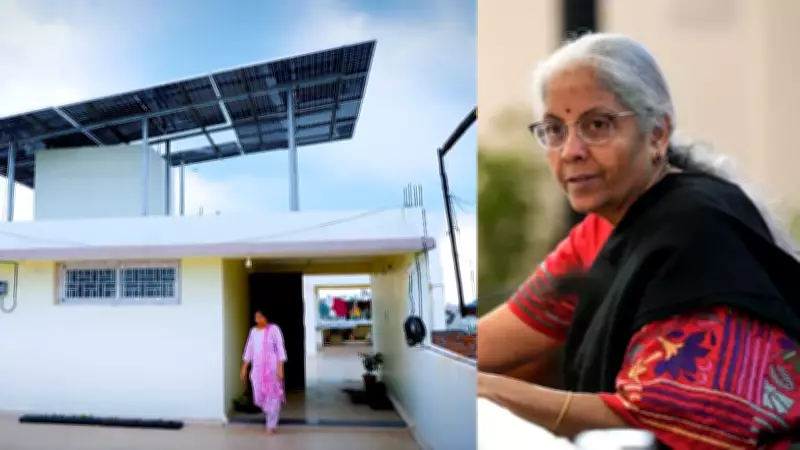
As the Union Budget for the 2026–27 financial year approaches its presentation date of February 1, a Sunday, the housing sector is poised to remain a central focus area. Allocations for the Pradhan Mantri Awas Yojana (PMAY) are under close observation, reflecting the government's continued commitment to affordable housing initiatives.
Historical Context and Budgetary Trends
Housing has been a cornerstone of the government's development agenda since May 2014, when Prime Minister Narendra Modi outlined a vision to provide pucca houses to economically disadvantaged families across both rural and urban landscapes. This vision materialized with the launch of the Pradhan Mantri Awas Yojana—Urban in 2015 and Pradhan Mantri Awas Yojana—Gramin in 2016.
Budget allocations for PMAY have seen significant fluctuations over recent years. For PMAY-Urban, PMAY-Urban 2.0, and PMAY-Gramin, the figures stood at Rs 40,260 crore in FY21, surged to Rs 90,020 crore in FY22, then adjusted to Rs 73,615 crore in FY23, Rs 43,454 crore in FY24, Rs 47,596 crore in FY25 (Revised Estimates), and Rs 78,126 crore in FY26 (Budget Estimates).

Recent Cabinet Approvals and Expansion
On August 9, 2024, the Union Cabinet greenlit financial assistance for constructing an additional two crore houses. This assistance maintains the existing unit rates of Rs.1.20 lakh in plain areas and Rs.1.30 lakh in the North Eastern Region States, Hill States of Himachal Pradesh and Uttarakhand, and the Union Territories of Jammu & Kashmir and Ladakh.
PMAY–Gramin: Empowering Rural India
Under the Pradhan Mantri Awas Yojana–Gramin (PMAY-G), the emphasis has consistently been on housing the most impoverished segments of society. Beneficiary selection involves a rigorous three-stage validation process, incorporating the Socio-Economic Caste Census (SECC 2011), Awaas+ (2018) surveys, Gram Sabha approvals, and geo-tagging.
The scheme leverages IT-enabled systems, Direct Benefit Transfer (DBT), and geo-tagged photographs at various construction phases to ensure transparency and expedite fund disbursement.
Against an overarching target of 3.32 crore houses under PMAY-G, 3.21 crore houses had been sanctioned as of November 19, 2024, with 2.67 crore houses completed. Over the past 11 years, the construction of 3.70 crore houses has been finalized, markedly enhancing living standards in rural regions.
Women Empowerment and Skill Development
A notable aspect of PMAY-G is its focus on women empowerment, with 74 percent of sanctioned houses owned by women either solely or jointly. The programme now aims to achieve 100 percent female ownership. Additionally, skill development has been prioritized, with nearly three lakh rural masons trained in disaster-resilient construction techniques.
Urban Housing and Infrastructure Advancements
Urban housing has also demonstrated steady progress. Under the two phases of the Pradhan Mantri Awas Yojana–Urban, 122.06 lakh houses had been sanctioned as of November 24, 2025.
Complementing this growth, urban services have expanded substantially. Door-to-door collection of municipal solid waste reached 98 percent of urban wards under Swachh Bharat Mission 2.0 by 2025–26. Furthermore, over 90 percent of the 8,067 Smart City Mission projects have been completed, with investments nearing Rs 1.64 lakh crore as of May 9, 2025.
Budget Presentation and Parliamentary Context
Finance Minister Nirmala Sitharaman is set to present her ninth consecutive Budget in Parliament, delineating the Centre's fiscal priorities, economic strategy, and policy direction for the forthcoming year.
The Budget will serve as the government's statement of accounts and signal its approach to resource allocation, offering insights into sectors likely to receive augmented support. Beyond mere fiscal numbers, it will function as a roadmap for the Union government's broader growth strategy. This presentation marks the first instance in recent history that the Union Budget is being tabled on a Sunday.
The Budget Session of Parliament commenced on January 28 and is scheduled to continue until April 2, providing a platform for extensive discussions on these critical allocations and policies.






