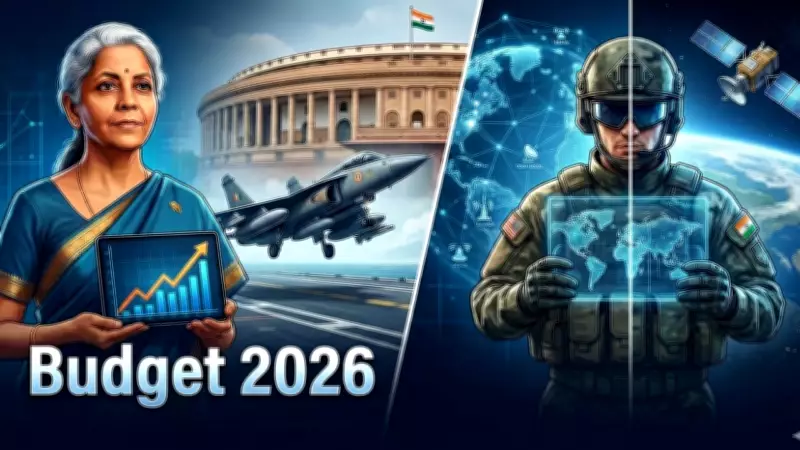
Defence Budget 2026-27: Experts Advocate Strategic Spending Hike Amid Geopolitical Shifts
As Union Finance Minister Nirmala Sitharaman prepares to present the Union Budget for 2026–27 on February 1, defence expenditure has once again emerged as a focal point of policy discussions. While the allocation for defence always garners significant attention in one of the world's largest economies, the current geopolitical backdrop presents distinct challenges compared to previous years. Intensifying geopolitical tensions, technology-driven conflicts, and India's expanding security calculus—which now encompasses cyber warfare, space, and hybrid threats—have collectively reshaped the discourse. In this context, The Times of India Online engaged with numerous economists and policy experts to evaluate whether India requires a substantial increase in its defence budget and, crucially, how such spending should be structured for maximum efficacy.
The Macro Picture: Analysing Defence Expenditure Trends
At first glance, India's defence budget has demonstrated a consistent upward trajectory. Official data reveals that total defence expenditure has risen from approximately Rs 2.94 lakh crore in 2015–16 to Rs 6.81 lakh crore in 2025–26, based on Budget Estimates. Similarly, defence capital expenditure, which funds modernisation and new acquisitions, has grown in absolute terms from Rs 83,614 crore in 2015–16 to Rs 1.92 lakh crore in 2025–26. However, when viewed as a percentage of nominal GDP, defence spending has declined over the past decade. In 2020–21, total defence expenditure accounted for around 2.4% of GDP, but by 2025–26, this ratio had decreased to about 1.9%. Defence capital expenditure has remained relatively flat, hovering between 0.5% and 0.6% of GDP for most of this period.
Dr DK Srivastava, chief policy advisor at EY India, emphasised that there is "a very strong case" for increasing India's defence budget, particularly capital spending. He advocated raising total defence expenditure to at least 3% of nominal GDP and maintaining it at that level consistently. "The share of defence capital expenditure in the government of India's total expenditure needs to go up in a sustained manner," he stated. It is important to note that as India's GDP expands, even a stable or slightly lower percentage can translate into a larger absolute defence budget. According to Stockholm International Peace Research Institute data, India spent $86 billion on military expenditures in 2024, ranking fifth globally.

Security Environment and the Rationale for Higher Capital Expenditure
India's evolving security landscape is a primary driver behind calls for enhanced defence spending, especially following recent strategic developments. Yuvika Singhal, an economist at QuantEco, noted that given the challenges emanating from India's neighbourhood, a higher defence capital outlay is a "natural corollary." She recommended channelling such spending toward military modernisation and strengthening indigenous production under the Aatmanirbhar Bharat framework. This perspective aligns with recent budgetary trends; in the Union Budget 2025–26, the government allocated a record Rs 6.81 lakh crore to the Ministry of Defence, marking a 9.53% increase over the previous year. Of this amount, Rs 1.80 lakh crore was earmarked for capital outlay for the armed forces, with Rs 1.12 lakh crore reserved for procurement from domestic industries.
The emphasis on indigenous sourcing reflects a broader strategic objective: reducing import dependence while building domestic industrial capacity. This push toward self-reliance has yielded tangible results; India's indigenous defence production reached a record Rs 1,27,434 crore in FY 2023–24, representing a 174% increase from Rs 46,429 crore in 2014–15, driven by sustained policy support under the Atmanirbharta initiative. Madan Sabnavis, chief economist at Bank of Baroda, anticipates that this direction will continue and intensify in Budget 2026. "Given the developments last year, there is a strong case to focus a lot on defence," he remarked, adding that capital expenditure for defence could see a higher increase compared to other infrastructure-heavy sectors like roads or railways.

Balancing Global Trends with Fiscal Realism
While the strategic rationale for higher defence spending is widely acknowledged, experts also caution against overlooking fiscal and execution realities. Ranen Banerjee, partner and government sector leader at PwC India, observed that defence spending has become a priority globally, with most countries ramping up allocations in response to geopolitical uncertainty. However, he stressed that budgetary allocations must align with procurement and absorption capacity. "If it is over-budgeted and under-spent, it may lead to some other deserving sectors missing out on allocations," Banerjee warned. This viewpoint underscores the importance of implementing reforms alongside funding increases. The Ministry of Defence has repeatedly highlighted the simplification of defence procurement procedures, greater use of multi-year contracts, and faster decision-making as critical enablers for effective fund utilisation.
Recent policy measures indicate progress in this direction, with the government simplifying export authorisation processes, rationalising standard operating procedures for defence exports, and launching a fully end-to-end digital portal to reduce time and paperwork for exporters. The introduction of Open General Export Licences and digital authorisations has further streamlined routine exports.
Defence Versus Other Capital Expenditure Priorities
Another layer of complexity arises from competing demands on government capital expenditure. Sujan Hajra, chief economist and executive director at Anand Rathi Group, pointed out that defence already constitutes a significant portion of India's capex. In FY25, defence capex amounted to around Rs 1.8 lakh crore, representing roughly 16% of total capital expenditure. Hajra expects that going forward, allocations to defence may rise at a relatively slower pace compared to sectors like roads and railways, which together command over 45% of capex. According to him, the government may seek to balance security imperatives with growth-enhancing infrastructure spending, particularly as India strives to become a developed nation by 2047.
However, other experts argue that this need not be a zero-sum game. Rishi Shah, partner and economic advisory services leader at Grant Thornton Bharat, asserted that when designed properly, defence expenditure can reinforce economic growth rather than crowd it out. "The answer is not an indiscriminate increase in defence outlays, but a strategic reorientation of spending toward domestic manufacturing, R&D, innovation and technology absorption," Shah explained. Such an approach, he added, would "strengthen strategic autonomy and industrial capabilities, ensuring that security imperatives reinforce—rather than dilute—India's long-term economic trajectory."
The Need for Sustained Increases and Predictability
A recurring theme in expert responses is the necessity for predictability and continuity in defence funding. Sachchidanand Shukla, group chief economist at Larsen & Toubro, advocated for "sustained rather than just one-off" hikes in defence capex. Large defence projects often span multiple years, and erratic funding patterns can lead to delays, cost overruns, and suboptimal outcomes. Historical data supports this argument; defence capital expenditure growth has been uneven, with sharp spikes in certain years—such as a 20.6% rise in 2020–21—followed by more modest increases or near stagnation in others. Experts contend that a steady, multi-year commitment would facilitate better planning by both the armed forces and domestic industry.
Linking Defence Spending to Aatmanirbharta and Indigenous Manufacturing
Nearly all experts emphasised the importance of tying higher defence spending to indigenous manufacturing. Rumki Majumdar, an economist at Deloitte India, stated that given rising geopolitical uncertainties, a calibrated increase in defence spending would be prudent, provided it is linked to domestic manufacturing and technology spillovers. This approach aligns with recent policy signals; the government has increasingly earmarked a large share of the defence modernisation budget for domestic procurement. As per data for 2025–26, 75% of the modernisation budget was reserved for procurement from domestic sources, with a significant portion specifically allocated to private sector participation.
The private sector's role in defence manufacturing has been steadily expanding. While Defence Public Sector Undertakings still account for about 77% of total defence production, the private sector's share increased from 21% in FY 2023–24 to 23% in FY 2024–25, reflecting its growing importance in India's defence ecosystem. Experts suggest that this shift could yield long-term economic benefits, as defence manufacturing is capital-intensive, technology-driven, and possesses strong multiplier effects. Investments in areas such as aerospace, electronics, artificial intelligence, and robotics can spill over into civilian industries, boosting productivity and employment.
Focus on R&D, Innovation, and Future Warfare Capabilities
Another area where experts see potential for deeper integration is defence research and development. The 2025–26 Budget allocated Rs 26,816.82 crore to the Defence Research and Development Organisation, marking a 12.4% increase over the previous year, with a substantial share earmarked for capital expenditure and collaborative projects with private players. Rishi Shah and others argue that future increases in defence budgets should prioritise R&D and innovation rather than just traditional platforms. Modern conflicts increasingly rely on cyber capabilities, space assets, unmanned systems, and data-driven warfare. Investing in these domains, experts assert, will not only enhance security but also position India as a technology leader.
India's growing strength in indigenous platforms is also reflected in its export portfolio, which now includes products ranging from bulletproof jackets, patrol boats, and helicopters to radars and lightweight torpedoes. While programmes like the Tejas fighter aircraft continue to mature, India's current export strength lies in a diverse array of proven, operational systems and components.
Defence Exports: Emerging as a Global Supplier
India's defence exports have become a cornerstone of the self-reliance narrative. Defence exports reached a record Rs 23,622 crore in FY 2024–25, registering a 12.04% increase over Rs 21,083 crore in FY 2023–24. Of this total, private sector exports accounted for Rs 15,233 crore, while DPSUs contributed Rs 8,389 crore. India supplied defence equipment—encompassing ammunition, arms, complete systems, and critical sub-systems—to approximately 80 countries in 2024–25. Exports to nations such as the United States, France, and Armenia underscore the growing global acceptance of Indian defence products. Notably, DPSU exports surged 42.85% year-on-year, reflecting their deeper integration into global supply chains.
The government has set ambitious targets of achieving Rs 3 lakh crore in defence manufacturing and Rs 50,000 crore in defence exports by 2029, positioning defence exports not merely as a commercial activity but also as an instrument of strategic diplomacy and global engagement.
Key Aspects to Monitor in Budget 2026
As Finance Minister Nirmala Sitharaman presents her ninth consecutive budget—a record in recent decades—the defence allocation will be scrutinised closely. Experts highlight several key indicators to watch:
- The growth rate of defence capital expenditure relative to revenue spending.
- The share of domestic procurement within the defence budget.
- Allocations for research and development, particularly in emerging technologies.
- Whether the government outlines a multi-year roadmap for defence spending.
With global uncertainties unlikely to diminish in the near future, policymakers face the challenge of balancing security imperatives with fiscal prudence and growth priorities. The consensus among experts suggests that India indeed needs to allocate more resources to defence, but the manner in which these funds are deployed may hold even greater significance than the total amount allocated.