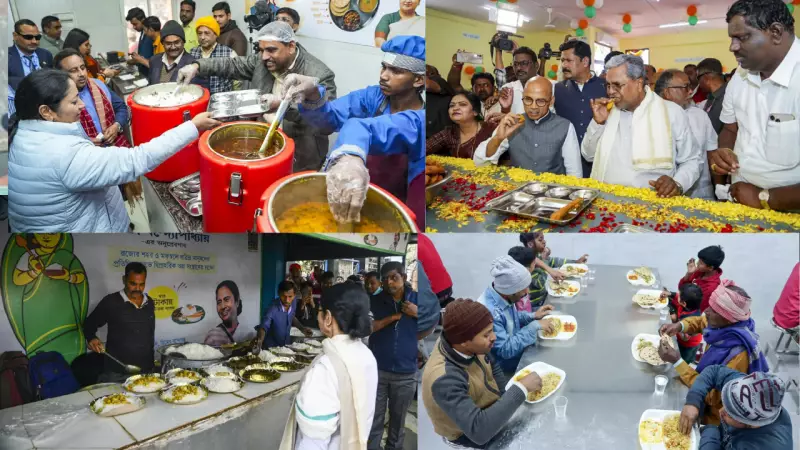
In the bustling heart of Lajpat Nagar, well before the midday crowds descend, a patient queue assembles outside a simple building. Construction workers in dust-covered clothes, elderly individuals leaning on sticks, and sanitation staff on a break all wait, a five-rupee coin in hand. Inside, the scene is one of organised efficiency: large pots of dal simmer, piles of fresh rotis are stacked high, and plates move quickly across the counter. For the price of a short bus ride, a complete, hot meal is provided. This is an Atal Canteen, the Delhi government's latest ambitious foray into providing affordable cooked food, marking a significant new phase in India's expanding landscape of state-run subsidised canteens.
A Symbolic Plate for the Urban Poor
The Delhi government officially inaugurated 45 Atal Canteens on December 25, coinciding with the 101st birth anniversary of former Prime Minister Atal Bihari Vajpayee. Plans are already underway to expand this network to 100 outlets in the near future. Priced at a deliberately symbolic Rs 5, the scheme is designed to primarily benefit daily-wage labourers, migrants, and the urban poor, with officials projecting it will reach over one lakh people daily once fully operational.
Each canteen offers a standardised, nutritious plate consisting of roti, rice, dal, seasonal vegetables, and pickle, providing between 700–800 calories and 20–25 grams of protein. Meals are served twice daily: lunch from 11:30 am to 2:00 pm and dinner from 6:30 pm to 9:00 pm, with each location expected to cater to nearly 1,000 individuals every day. The infrastructure includes LPG-based kitchens, industrial RO water plants, digital token systems, CCTV surveillance, and mechanisms for regular food quality testing by FSSAI and NABL-accredited labs. The project has a total budget allocation of Rs 104.24 crore.

The public response was swift and telling. Within the first 48 hours of operation, the newly opened canteens collectively served more than 33,000 meals, starkly underscoring the massive demand for affordable cooked food in the national capital.
Promise Meets Practical Challenges
The system is straightforward. "People come to the counter, pay Rs 5 and receive an invoice. They show it at the next counter and are served a full plate. The response from the public has been very positive," explained Rajeev Kumar Singh, a staff member at the Nehru Nagar canteen in South Delhi. Diners like Ekta, a local shop worker, appreciated the convenience, stating she would definitely return. Rakesh, another customer, praised the food quality, noting the perfectly cooked aloo gobhi and tasty dal.
However, the immediate rush also revealed initial teething problems. Auto-rickshaw driver Santosh reported waiting nearly 45 minutes only to find some items, like rice and pickle, had run out by 1:00 pm. Others felt the portions were insufficient for those engaged in physically demanding labour, and some noted a lack of clearly displayed timings, causing confusion. A staff member admitted that turnout had significantly exceeded expectations, with official data showing 17,587 meals served on Thursday and 15,805 on Friday across all canteens.
While Haryana Chief Minister Manohar Lal Khattar praised the model as a "commitment to providing dignified support," Delhi Congress chief Devender Yadav argued that the very necessity of such canteens highlights a deepening hunger crisis fueled by unemployment and inflation.
A National Movement with Deep Roots
Delhi's Rs 5 plate is not an isolated innovation but part of a decade-long national story reshaping how Indian states address hunger. The influential template was set by Tamil Nadu's Amma Unavagams in 2013. These municipal-run canteens sold idlis for Re 1 and full meals for Rs 5, eventually becoming permanent urban infrastructure. At their peak, around 650 canteens operated statewide, benefiting crores of people, including over 30,000 construction workers and migrants.
This model inspired a wave of replication across India, though each state adapted it differently:

Telangana's Annapurna canteens, launched in 2014, relied on partnerships with charities and NGOs, scaling to 150 outlets in Hyderabad. Odisha's Aahaar Yojana (2015) strategically placed kitchens near government hospitals to aid patients' attendants. Rajasthan's journey
Karnataka's Indira Canteens faced delays and allegations but persisted, with plans to expand to 250 outlets in Bengaluru. Andhra Pradesh's Anna Canteens were shut down in 2019 only to be revived in 2024 due to public pressure, serving 65 lakh meals within months of reopening. Maharashtra's Shiv Bhojan Thali and schemes in Madhya Pradesh, Haryana, and West Bengal further illustrate the nationwide spread of this idea.
The Unavoidable Return of the Subsidised Plate
A clear pattern emerges across states. While names, prices, and operational models differ, the core logic is consistent: in urban India, subsidised cooked food fills a critical gap left by grain-based welfare systems. Many states attempted to wind down these schemes, only to revive them later, discovering that the political and social cost of withdrawal is too high. Once offered, the plate becomes a promise.
What brings governments back is not merely ideology but hard arithmetic. With an estimated 172 million undernourished people in India and a Supreme Court mandate to ensure food access for unorganised workers, the need is undeniable. For low-income earners, one subsidised meal a day can save 5–10% of their monthly income.
Unlike ration shops, these canteens are highly visible, situated in labour hubs and near hospitals, serving as a tangible symbol of state support. The Delhi Atal Canteens, therefore, represent not a beginning, but a significant return to a proven solution—a hot plate of food served without questions, offering not just calories but a daily dose of dignity for the urban poor.