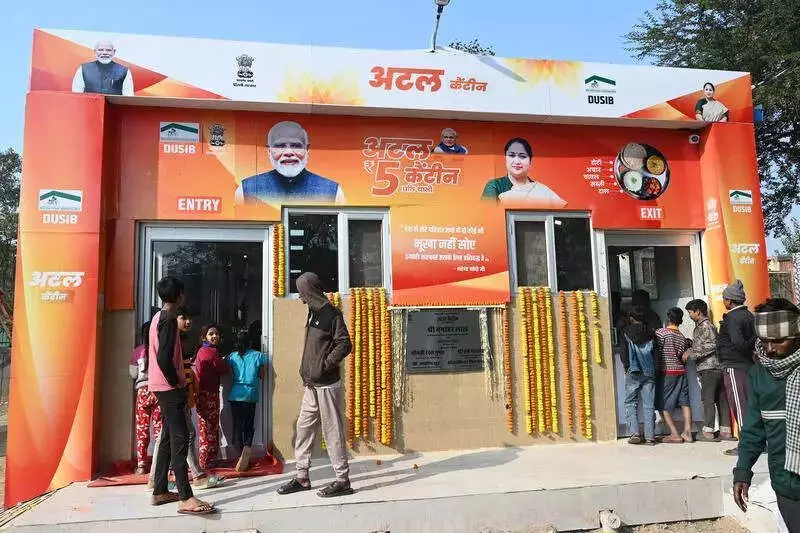
A day after Chief Minister Rekha Gupta inaugurated 45 subsidised Atal Canteens across the national capital, a reality check on Friday revealed a starkly uneven implementation of the ambitious scheme. The initiative, which promises nutritious meals for just five rupees, presented a patchwork picture across the city, with some locations bustling with activity and others still under construction.
A Tale of Two Realities: From Bustling Hubs to Bare Structures
The vision behind the canteens is clear: to provide healthy and affordable meals to economically disadvantaged groups like daily-wage workers, poor families, and residents of informal settlements. Government officials stated the locations were chosen based on proximity to such populations. Each canteen is designed to serve 500 plates daily on a first-come, first-served basis during afternoon and evening slots, potentially catering to nearly 1,000 people every day.
At Nehru Nagar, the scheme's potential was on full display. By 11:30 AM, the official opening time, a long queue had formed outside the bright orange structure. Inside, a staff of ten worked briskly, serving a steaming hot menu of rice, dal, roti, pickle, and gobhi aloo. "The response from the public has been very positive," said staffer Rajeev Kumar Singh, explaining the simple payment and collection process.

Visitors like Rakesh praised the meal quality, saying, "The gobhi aloo was cooked perfectly and the dal tasted great. At this price, what more can one ask for?" For many, it was the assurance of a complete meal at an unimaginable price.
Challenges Emerge Amid High Demand
However, the high demand also exposed teething problems. Some, like auto-rickshaw driver Santosh, complained of long waits and items running out. "I stood in line for about 45 minutes... by which time the rice and pickle had run out," he said. Labourer Rakesh pointed out that the portions might be insufficient for those engaged in physically demanding work. Others noted the lack of displayed timings, causing confusion.
A staffer at Nehru Nagar admitted the turnout exceeded expectations, with nearly 700 people arriving for the afternoon session against a prepared capacity of 500. "In the end, we distributed the remaining food for free," he said.
If Nehru Nagar reflected the scheme's promise and pressure, the scene was less reassuring elsewhere. In Anna Nagar, part of the Jangpura constituency, only a skeletal structure stood adorned with marigold garlands, with construction sounds echoing. A resident doubted it would open before January. At Sheikh Sarai and Kalkaji, preparations were underway but meals were yet to be served, with workers indicating starts on Saturday or the following day.
Official Data and the Road Ahead
Despite the uneven start, official data showed significant uptake. On Thursday, the canteens served lunch and dinner to 17,587 people. On Friday, 10,696 people had lunch and 5,109 had dinner, totalling 15,805 for the day.
A senior government officer, speaking anonymously, assured that all 45 canteens would be functional within the next four to five days, with at least 15 already fully operational. "They are serving food to the poor, who would have otherwise gone hungry or been forced to buy much more expensive food," the officer stated.
The rollout of the Atal Canteen scheme underscores the gap between announcement and execution. While the promise of a five-rupee meal has clearly resonated with Delhi's struggling populations, the inconsistent pace of implementation suggests that turning this well-intentioned pledge into a consistent, citywide service will require more time and streamlined efforts.