

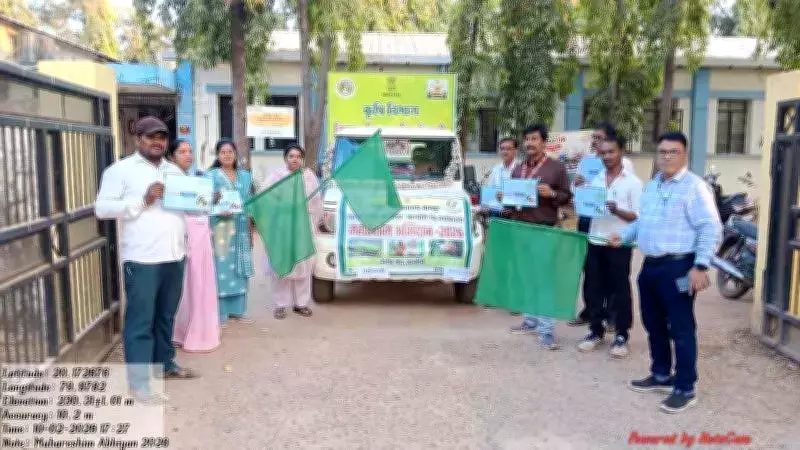
Gadchiroli District Launches 'Reshim Rath' to Promote Sericulture Under Mahareshim Abhiyan-2026
In a significant move to boost silk production and rural livelihoods, the Gadchiroli district Silk Office in Armori flagged off a 'Reshim Rath' (Silk Chariot) on February 10. This initiative is a key component of the Mahareshim Abhiyan–2026, a statewide campaign aimed at promoting sericulture and disseminating information about government schemes at the village level.
Official Launch and Key Attendees
The awareness vehicle was inaugurated by District Superintendent Agriculture Officer Priti Hiralakar, with Assistant Commissioner of Fisheries Samir Dongre gracing the occasion. The event saw participation from several officials, including Sericulture Development Officer A V Wasnik, Senior Technical Assistant G R Uike, Field Assistants A N Nakhale and C V Vitthale, along with other staff members. Their presence underscored the collaborative effort to advance agricultural diversification in the region.
Campaign Implementation and Registration Details
The Mahareshim Abhiyan–2026 is being rolled out across Maharashtra under the guidance of the textiles department and the sericulture directorate based in Nagpur. Farmers interested in venturing into sericulture are required to register between February 10 and March 5. Registration is completely free for tasar silk farmers, while those eligible for mulberry cultivation must pay a nominal fee of Rs 500 per acre and submit necessary documents.

Economic Benefits and Subsidy Schemes
Sericulture Development Officer A V Wasnik highlighted that sericulture, being an agriculture-based activity, allows farmers to rear silkworms on their own land and earn directly from cocoon production. He estimated that farmers can achieve a net profit ranging from Rs 1.50 lakh to Rs 2 lakh per year through this venture.
Under the centrally sponsored Silk Samagra–2 scheme, small and marginal farmers are eligible for substantial subsidies. They can receive up to Rs 3,75,000 for one acre of mulberry plantation, covering expenses such as mulberry saplings, irrigation systems, rearing houses, rearing materials, and disinfectants. Additionally, farmers from villages covered under the Nanaji Deshmukh Krishi Sanjivani Yojana (POCRA) can avail a subsidy of Rs 3,25,125, further reducing financial barriers.
Appeal to Farmers and Contact Information
The district silk office in Armori has made a fervent appeal to farmers across Gadchiroli to embrace sericulture and leverage the available schemes for economic upliftment. For further details and assistance, farmers are encouraged to contact the district silk office located at Wadsa Road, Armori. This initiative aims to transform local agriculture by integrating silk farming into traditional practices, fostering sustainable income streams and rural development.






