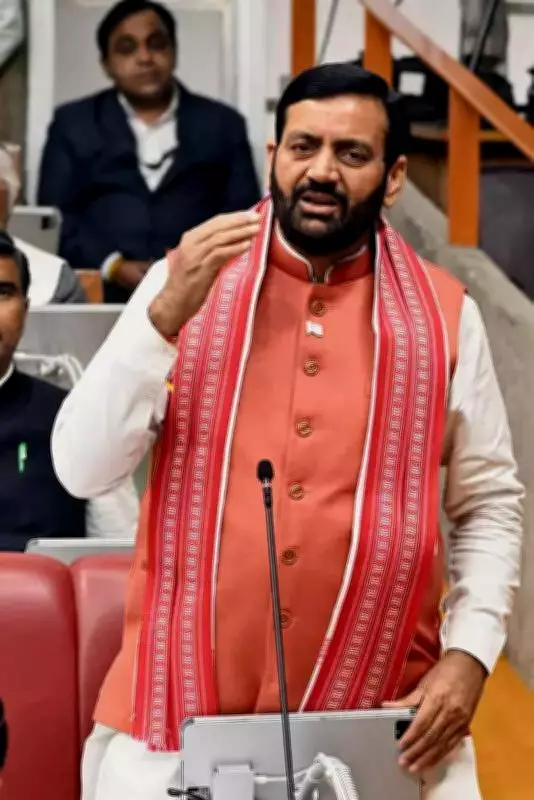
Amidst chaotic and stormy scenes on the fourth day of the Budget Session, Haryana Chief Minister Nayab Saini made a significant announcement to the House regarding a major infrastructure development. He informed legislators that the state government has granted approval for the final alignment of the Gurugram–Faridabad–Noida–Greater Noida Namo Bharat RRTS-cum-Metro Corridor, a transformative regional transit project.
Project Details and Vision
Chief Minister Saini stated that the Detailed Project Report (DPR) is currently being finalized, with clear directions issued to the National Capital Region Transport Corporation (NCRTC). The NCRTC is the Government of India agency tasked with executing this ambitious initiative. He emphasized that the project aligns perfectly with Prime Minister Narendra Modi's vision under the "Namo Bharat" initiative, which seeks to connect major economic hubs across the nation through fast, safe, and modern transit systems.
The proposed corridor will span approximately 64 kilometres, with a substantial portion—nearly 52 kilometres—falling within Haryana's territory. More than just a conventional rail line, this project is envisioned as a comprehensive regional mobility network that will integrate key economic centres such as Gurugram, Faridabad, and Noida within the National Capital Region (NCR).

Key Benefits and Objectives
The corridor is expected to deliver multiple benefits:
- Provide seamless and high-speed travel for lakhs of daily commuters
- Significantly reduce traffic congestion on existing road networks
- Contribute positively to environmental sustainability by promoting public transit
- Foster economic growth through improved connectivity
Gurugram Segment Specifications
In the Gurugram segment, an integrated RRTS and Metro section covering about 14.5 kilometres has been approved between IFFCO Chowk and Gwal Pahari. This section will feature several key stations including:
- Sector-29
- Millennium City Centre
- Sector-52
- Wazirabad
- Sector-57
- Sector-58/61
This Gurugram section will interconnect with multiple existing transit networks:
- Delhi Metro Yellow Line
- Gurugram Metro Corridor
- Rapid Metro network
The objective extends beyond mere travel time reduction to creating a fully integrated transit ecosystem for the entire city.
Faridabad Segment Specifications
Similarly, in the Faridabad region, an integrated section of approximately 16 kilometres has been approved from Sainik Colony to Badshahpur. This stretch will cover important areas including:
- The NIT region
- Bata Chowk
- Sectors 12 to 15
- Key parts of New Faridabad
This Faridabad section will connect with the Delhi Metro Violet Line, further strengthening regional connectivity and accelerating both industrial and residential development in the area.
Broader Economic and Urban Impact
Chief Minister Saini highlighted that the corridor will open new avenues for investment, employment generation, and balanced urban growth throughout Haryana. Considering the rising population and increasing traffic pressure in cities like Gurugram and Faridabad, the project is being specifically designed to meet future mobility demands for decades to come.
"With close coordination between the Central and State Governments, our administration is fully committed to ensuring timely execution of this transformative project," stated Chief Minister Nayab Singh Saini.
Additional Announcement: Chhachhrauli Land Ownership
Alongside the major transport announcement, the Chief Minister made another pivotal declaration concerning land ownership in Chhachhrauli. He revealed that land under Khasra numbers 125, 152, and 134 has remained under government ownership since 1887. However, this land was long recorded as 'Gair Mumkin Aabadi' (non-cultivable residential land), with residents constructing houses there for decades. Property registrations for these structures continued until 2020, indicating longstanding residential use despite the official land classification.