Buying a home is a cherished dream for many individuals who work tirelessly for years to turn it into reality. However, in India's urban housing market, soaring property prices, heavy loan burdens, and a limited supply of affordable homes often pose significant challenges. This is where government housing schemes step in, aiming to make homeownership more attainable for salaried families, lower-income households, and first-time entrants into the market. India's current housing support framework includes a variety of schemes tailored for first-time homebuyers. The following information is sourced from official scheme websites.
Who Are First-Time Homebuyers?
In government housing terminology, a first-time homebuyer is typically an individual applying for housing assistance without already owning an eligible house under the scheme's rules. In practice, this is verified through a declaration that the applicant does not own a house in the relevant city, state, or scheme category, depending on the program. This classification is crucial as it enables the government to target assistance towards those who genuinely need an entry point into the housing market. Most such schemes focus on Economically Weaker Sections (EWS), Low Income Group (LIG), and in some cases, Middle Income Group (MIG) households.
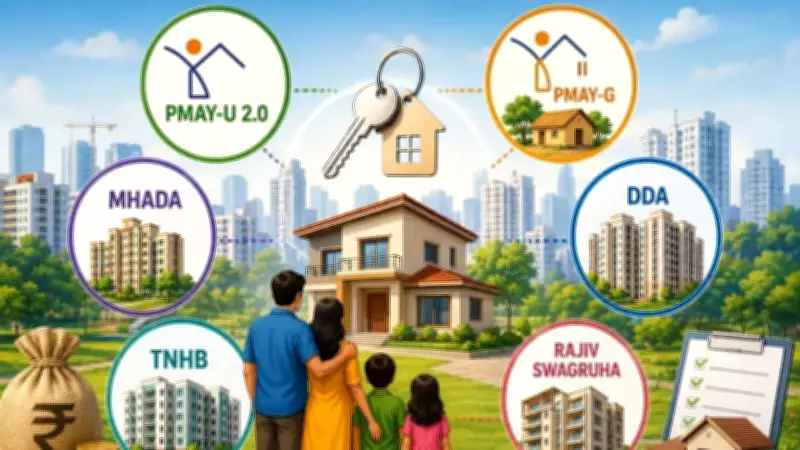
Pradhan Mantri Awas Yojana – Urban 2.0 (PMAY-U 2.0)
PMAY-U 2.0 is the Government of India's flagship urban affordable housing mission. It remains the cornerstone of central housing support for urban families, designed to help eligible households access affordable housing through various intervention models rather than a single route. Key features of PMAY-U 2.0 include support for urban affordable housing for eligible households, a focus on EWS, LIG, and MIG segments, and operation through structured mission verticals such as beneficiary-led construction, affordable housing partnerships, and slum redevelopment. For first-time buyers, PMAY-U 2.0 is significant because it reduces the barriers to entering the housing market and integrates housing support with official planning and monitoring systems like geo-tagging and digital tracking.

Pradhan Mantri Awas Yojana – Gramin (PMAY-G)
Pradhan Mantri Awas Yojana – Gramin (Rural) is the rural housing component of India's affordable housing mission. While PMAY-U 2.0 targets urban areas, PMAY-G is designed for rural households lacking adequate housing. The scheme aims to provide pucca houses with basic amenities to eligible rural families, improving living conditions across villages. Introduced to replace the earlier Indira Awaas Yojana, PMAY-G focuses on quality housing with better construction standards, sanitation facilities, electricity access, and clean cooking support through convergence with other welfare schemes. Main features include financial assistance for constructing pucca houses in rural areas, targeting houseless families and those living in kutcha or damaged houses, encouraging better construction techniques and disaster-resistant designs, supporting convergence with schemes for toilets, electricity, LPG connections, and drinking water, and using technology-based monitoring and geo-tagging for transparency. For first-time homebuyers in rural India, PMAY-G is especially significant as it provides economically weaker households an opportunity to own a permanent and safer home, playing a major role in improving rural housing infrastructure and reducing housing insecurity.
State-Level Housing Schemes
State housing schemes are equally important as central schemes because land prices and housing demand vary widely across regions. In many cases, state boards offer the most practical route for first-time buyers through regulated allotment systems, lottery draws, or first-come-first-served (FCFS) registration. Common features include affordable flats or plots, transparent allotment processes, online registration and notifications, and eligibility checks based on local rules. These schemes often assist buyers in high-cost urban areas where private housing is out of reach.

MHADA (Maharashtra Housing and Area Development Authority)
MHADA is one of India's most renowned housing authorities. Its official registration portals indicate that it continues to offer housing through FCFS and lottery-based systems, making it especially valuable in Maharashtra, where urban property prices—particularly in and around Mumbai—are among the highest in the country. MHADA offers regular housing lotteries, FCFS registration for some schemes, online application and status tracking, and affordable housing opportunities for eligible applicants. For first-time buyers, MHADA provides a structured and more affordable entry into a very expensive market.
DDA Housing Scheme (Delhi Development Authority)
DDA remains a major housing provider in Delhi. Its official site lists multiple current schemes such as DDA Nagrik Awas Yojna 2026, DDA Premium Housing Scheme 2026, DDA Towering Heights Scheme 2026, and earlier DDA Janta Awaas Yojna 2025, all published through official notices and brochures. DDA offers organized housing options in Delhi, flats under different income categories, online notice and allotment systems, and a route into regulated housing in the capital. For first-time buyers in Delhi, DDA schemes provide official, planned, and relatively affordable housing opportunities compared to the private market.
TNHB (Tamil Nadu Housing Board)
TNHB develops residential projects and affordable housing options in Tamil Nadu. Its official portal provides active notifications, own-housing scheme rules, and online housing-related services, along with eligibility restrictions including conditions on whether an applicant has already received similar benefits. TNHB offers apartments and plots, serves different income categories, publishes official notifications and allotment rules, and helps buyers access planned housing in Tamil Nadu. For many first-time buyers, TNHB provides a safer and more affordable alternative to the open real estate market.
Rajiv Swagruha Scheme (Telangana)
Rajiv Swagruha is Telangana's housing initiative for flats and plots. Its official portal displays current notifications, availability of flats, allotment updates, and eligibility information, and appears to use online application and lottery-style processes for certain projects. The scheme provides affordable flats and open plots, publishes official notification and allotment details, supports transparent application processes, and targets eligible buyers looking for government-backed housing. For first-time homebuyers in Telangana, this scheme offers a government-managed path to property ownership in an organized urban setting.
Other Aspects First-Time Buyers Should Keep in Mind
Before applying for any scheme, buyers should always check income eligibility, location of the project, possession timeline, maintenance charges, legal approvals, and whether the benefit is a subsidy, flat allotment, or plot allotment. Government housing schemes play a crucial role in helping first-time homebuyers transition from renting to owning. PMAY-U 2.0 is the main national framework for urban affordable housing, PMAY-G serves rural housing, and state bodies like MHADA, DDA, TNHB, and Rajiv Swagruha continue to create practical housing opportunities across India. Together, these schemes make homeownership more realistic for families who might otherwise be excluded from the market.
Disclaimer: Scheme availability, subsidy benefits, and eligibility rules may change over time and must always be verified through official government portals before applying.