

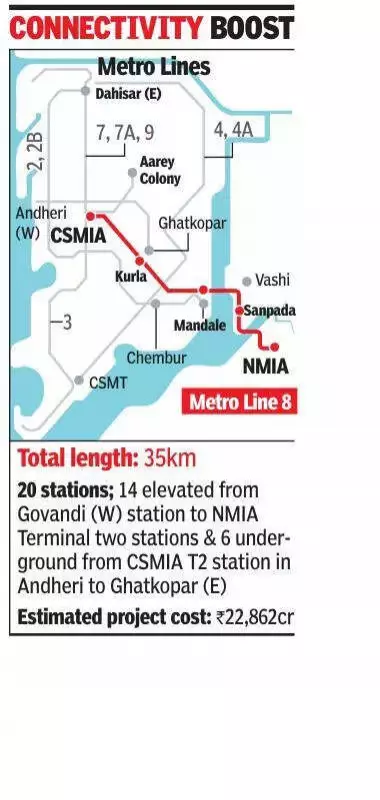
The Maharashtra cabinet sub-committee on infrastructure has given its crucial approval to the ambitious Metro Line 8 project, which will create a vital transit link between Mumbai's two international airports. This significant decision was taken during a meeting held on Tuesday, marking a major step forward in enhancing regional connectivity.
Connecting Mumbai's Aviation Hubs
The 35-kilometer Metro Line 8 will establish a direct connection between Chhatrapati Shivaji Maharaj International Airport (CSMIA) in Andheri and the upcoming Navi Mumbai International Airport (NMIA). According to Chief Minister Devendra Fadnavis, the route will feature 20 strategically located stations along its path.
Route Details and Engineering
The alignment will begin with a 9-kilometer underground section running from Andheri to the Eastern Express Highway at Ghatkopar. From there, the metro will transition to an elevated track along the Ghatkopar-Mankhurd Link Road, continuing until it reaches Mankhurd. This dual-mode construction approach addresses both urban density and engineering feasibility concerns.

Intermodal connectivity has been carefully planned, with the line offering connections to Lokmanya Tilak Terminus and two additional railway stations. This integration with existing rail infrastructure will create seamless transit options for commuters across the Mumbai Metropolitan Region (MMR).
Funding Model and Timeline
The project will be executed through a public-private partnership (PPP) model, making it Mumbai's second metro corridor to utilize this approach after the Versova-Andheri-Ghatkopar Metro 1 line. Fadnavis explained the financial structure: "The Centre and state will each provide 20% equity, with the remaining 60% coming from private enterprise participation."
Officials have set an ambitious completion target of approximately 3.5 years for the entire project. Once operational, Metro Line 8 is projected to handle nearly 9 lakh (900,000) passengers daily, significantly easing congestion on existing transport networks.
Strategic Network Integration
Metro Line 8 will form intersections with three other metro corridors, creating a comprehensive transit network that enhances connectivity between Mumbai, Navi Mumbai, and the broader MMR. This integration is part of a larger metro expansion strategy that includes several complementary projects.
Metro Line 8A is being planned to connect Belapur to Mankhurd, which serves as the endpoint for Metro Line 2B (Dahisar-Andheri-Kurla-Mandale). Furthermore, Metro Line 2B will offer an interchange with Metro Line 4A, which links Wadala to Thane via the Eastern Express Highway, LBS Road, and Ghodbunder Road.
Broader Development Impact
According to officials from CIDCO (City and Industrial Development Corporation), direct connectivity between Mumbai's two international airports will catalyze development across the MMR and contribute to achieving India's goal of becoming a $5 trillion economy. The improved transit infrastructure is expected to reduce travel time substantially while accommodating growing passenger demand at both aviation facilities.
Future Expansion Plans
CIDCO has outlined comprehensive plans to expand the Navi Mumbai Metro network beyond the immediate Line 8 project. These include:
- Extension of the existing Line 1 to create a direct connection between Belapur and NMIA
- Proposed Lines 2, 3, and 4 to link Taloja to NMIA, enhancing connectivity for residential and industrial hubs
- Two new metro routes within the Navi Mumbai Airport Influence Notified Area (NAINA)
When combined with these planned developments, the total metro network in Navi Mumbai and NAINA is expected to span approximately 70 kilometers. This extensive infrastructure will ensure efficient transit for passengers across the region, supporting both economic growth and improved quality of life for residents.
The approval of Metro Line 8 represents a significant milestone in Mumbai's ongoing transformation into a world-class metropolitan region with integrated, multi-modal transportation systems designed to meet the needs of its growing population and economy.






