MSEDCL Denies Solar Capacity Restrictions Amid Industry Criticism in Maharashtra
The Maharashtra State Electricity Distribution Company Limited (MSEDCL) has firmly rejected allegations of imposing arbitrary capacity restrictions on the PM Surya Ghar Muft Bijli Yojana. However, representatives from the solar industry have dismissed the utility's clarification as an 'eye-wash,' claiming it does not reflect the ground reality faced by consumers and installers.
MSEDCL's Official Stance on Capacity Approvals
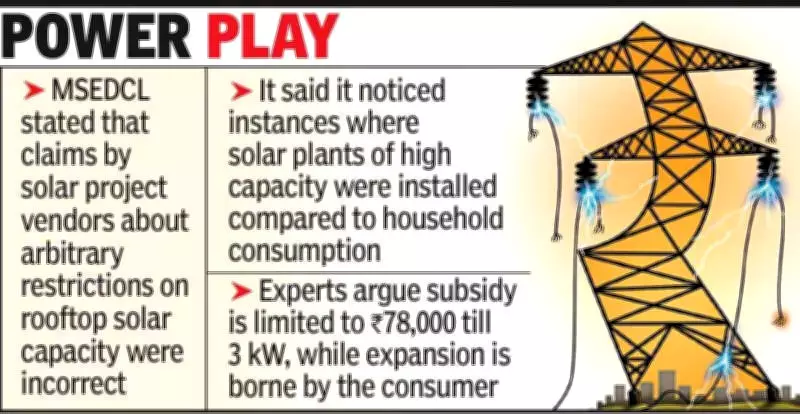
On Friday, MSEDCL issued a statement addressing claims by solar project vendors about restrictive practices. The utility clarified that approvals for rooftop solar installations are not granted arbitrarily but are based on two key factors: the consumer's sanctioned load and their actual electricity consumption patterns. MSEDCL emphasized that in cases where a higher capacity is genuinely required, approvals are provided after thorough technical scrutiny and on-site inspections to ensure compliance with scheme guidelines.
According to MSEDCL, the primary objective of the PM Surya Ghar Yojana is to benefit ordinary domestic consumers. The utility reported observing instances where solar plants with disproportionately high capacity were installed relative to household consumption. In these cases, subsidies were availed from the Central government, and later, the electricity connections were converted to commercial categories, leading to alleged misuse of subsidy benefits. This practice has prompted MSEDCL to implement stricter oversight measures.

Solar Industry's Counterarguments and Concerns
In response, solar industry representatives have strongly contested MSEDCL's position. They argue that the subsidy structure itself limits benefits, with subsidies capped at ₹78,000 for installations up to 3 kW, and any capacity expansion beyond that must be borne entirely by the consumer. This, they claim, reduces incentives for misuse.
Industry representative Sudhir Budhay labeled MSEDCL's clarification as 'misleading.' "Even consumers with higher sanctioned loads are not getting approvals as per their entitlement. The issue is not restricted to domestic connections. Commercial and industrial consumers are also facing similar hurdles," he asserted. Budhay's comments highlight broader concerns that delays and restrictive interpretations by MSEDCL are slowing down solar adoption across Maharashtra, potentially affecting investor confidence in the renewable energy sector.
MSEDCL's Automated System and Vendor Accountability
MSEDCL also addressed complaints about vendor practices, noting that some vendors were pressuring consumers to opt for higher-capacity systems even when their requirements were limited to 1 kW or 2 kW. This not only increased the financial burden on consumers but also raised questions about the integrity of the subsidy process. To mitigate this, MSEDCL has introduced an automated system that links permissible solar capacity directly to sanctioned load and historical consumption data. Requests for capacity that exceed regular usage patterns are now subjected to mandatory physical inspections to verify necessity.
Scheme Performance and Subsidy Details
Under the PM Surya Ghar Muft Bijli Yojana, the Central government provides substantial subsidies to encourage rooftop solar adoption:
- ₹30,000 for 1 kW installations
- ₹60,000 for 2 kW installations
- ₹78,000 for 3 kW installations
Maharashtra has emerged as a leader in the implementation of this scheme, with impressive statistics to date:
- 4.53 lakh consumers have installed rooftop solar systems
- Total installed capacity stands at 1,722 MW
- Subsidies disbursed amount to ₹3,162 crore
Despite these achievements, the ongoing dispute between MSEDCL and the solar industry underscores significant challenges in balancing scheme integrity with consumer accessibility. As Maharashtra continues to promote renewable energy, resolving these conflicts will be crucial for sustaining momentum in solar adoption and ensuring that benefits reach intended recipients without bureaucratic hurdles.