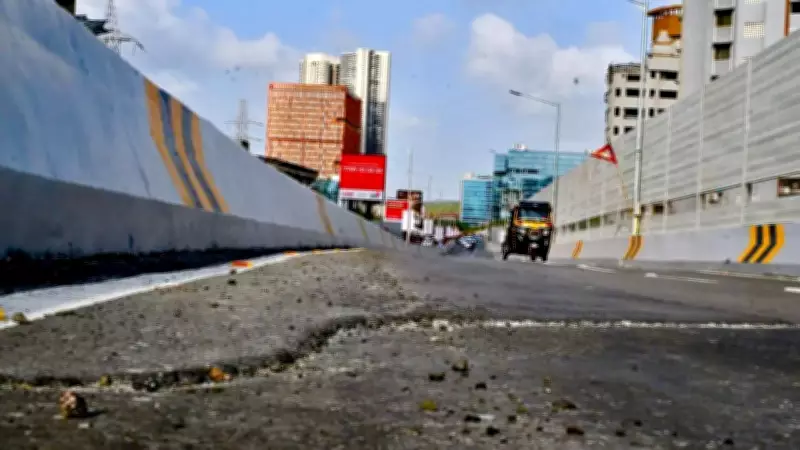
MUMBAI: Within hours of the opening of the Mrinal Tai Gore flyover extension in Goregaon, built at a cost of Rs 248 crore, social media erupted with criticism over the quality of its road surface. Users posted comments such as, "The surface looks as if it won't last one monsoon," "So much patchwork," and "This is tragic. How can this even be opened with such shoddy work? I'm sure they'll close it tomorrow citing 'technical issues'." The extension project received administrative approval in 2018 and was opened nearly eight years later on June 6, 2026.
Mayor's Response and Opposition Criticism
Mumbai Mayor Ritu Tawde, who inaugurated the flyover on Saturday, stated there would be zero tolerance for any substandard work and announced that she would conduct an inspection of the site on Monday. "If, during my visit, substandard work is found, I will be demanding an immediate technical audit and inquiry by a reputed independent institution such as IIT Bombay. Should the audit establish deficiencies in the quality of work, I will seek the immediate blacklisting of the contractor, withholding of all pending payments, and action against the officials responsible for supervising the project. Accountability must be fixed without delay," the mayor said.
However, no one was willing to accept the justification, and the opposition also targeted the project. NCP (SP) leader Anish Gawande posted, "Welcome to Mumbai's newest flyover worth Rs 248 crore. At 750 metres, that's Rs 33 lakh a metre. The flyover is named after the iconic Mrinal Tai Gore, who spent her life fighting for the dignity of ordinary Mumbaikars. After seven years, three cost revisions and daily penalties on the contractor, is this really how we honour her legacy? But this is the standard under the triple-engine sarkar — cut the ribbon, click the photo and leave the potholes for the public. Bajao taali." On Saturday night, Shiv Sena (UBT) leader Aaditya Thackeray and Mumbai Congress president Varsha Gaikwad also questioned the quality of the newly opened flyover.

BMC's Clarification
The Brihanmumbai Municipal Corporation (BMC) issued a clarification stating that based on a technical inspection by the bridges department, the current appearance of the surface does not indicate any structural deficiency, design flaw, workmanship defect, or surfacing failure. All bridge works have been executed strictly in accordance with approved designs and prescribed technical specifications. "However, extra grit that is observed on the surface will be removed, and the grit needed to ensure an anti-skid surface will be rolled using a lightweight roller," the municipal administration stated.
The BMC further explained that the joints visible on the surface are part of the technical process involved in laying mastic asphalt. There has been no compromise in the bridge's structural safety, stability, or quality. All work has been completed in accordance with prescribed technical standards and safety requirements. The characteristics of newly laid mastic asphalt are such that the process of spreading stone chippings is intentionally carried out to provide necessary friction and skid-resistance for vehicles, as the surface is initially relatively smooth. As a result, temporary variations in colour or texture may be visible. However, this process is essential for ensuring vehicular safety.
The BMC bridges department noted observations and comments made by citizens, elected representatives, and various stakeholders on social media regarding the apparent unevenness and patch-like appearance of portions of the road surface. It clarified that a 40 mm thick mastic asphalt wearing course has been provided on the bridge carriageway. It is the nature of mastic asphalt that it looks patchy and rough immediately after laying, especially where it is done manually. However, as more vehicles ply on the road, the surface starts becoming even and tidy.

"Mastic asphalt is a specialised bituminous surfacing material widely used on bridge decks because of its excellent waterproofing properties, long-term durability, resistance to rutting, and extended service life. The bridge's geometric configuration includes long horizontal curves and varying levels of superelevation at different locations, making it relatively complex. Consequently, the mastic asphalt wearing course was laid in stages and in separate sections. As a result, certain construction joints between adjoining sections are currently visible and may resemble patches at some locations. However, mastic asphalt is a highly dense and voidless material. Under traffic loads and varying atmospheric temperatures, it exhibits self-healing and flow characteristics. Once regular and continuous vehicular traffic begins, these joints will gradually blend into the surrounding surface, resulting in a more uniform appearance and a smoother riding experience over time," said the BMC.