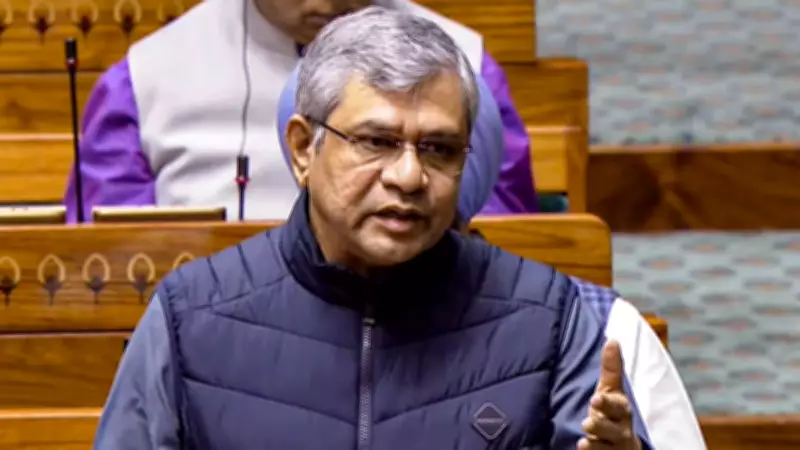
Railway Minister Ashwini Vaishnaw has unveiled a transformative railway development plan for Maharashtra, with a substantial budget allocation of Rs 23,926 crore. This ambitious initiative aims to revolutionise travel and connectivity across the state through new high-speed corridors, freight networks, and extensive modernisation efforts.
High-Speed Rail Corridors to Redefine Commuting
At the heart of this announcement are two major high-speed rail corridors that promise to drastically reduce travel times between key economic hubs. The Mumbai-Pune corridor is set to slash the journey to a mere 48 minutes, effectively making the two cities practically adjacent for daily commuters.
"The travel time will be significantly reduced between Mumbai and Pune to just 48 minutes, creating unprecedented connectivity between these metropolitan centers. This will enable people to commute easily between the two cities for work and return immediately," Vaishnaw explained during the announcement.

Pune-Hyderabad Corridor: Connecting IT and Manufacturing Hubs
Equally significant is the Pune-Hyderabad high-speed corridor, which will connect two major technology and manufacturing centers. "Both Pune and Hyderabad are major IT, electronics and manufacturing hubs. Connecting them with a high-speed corridor through the bullet train network will be highly beneficial for commuters, with travel time reduced to one hour fifty-five minutes," the Railway Minister added.
Rajesh Kumar Verma, Divisional Railway Manager of Pune, provided route specifics: "The new high-speed rail corridor will begin from Mumbai, passing through Lonavala, Pune, Daund, with the later stretch connecting to Secunderabad."
Phased Implementation and Operational Strategy
Addressing operational aspects, Vaishnaw outlined a phased approach to service frequency. "In the initial period after inauguration, bullet train frequencies will have gaps of one or two hours. After the project stabilises, frequencies will increase significantly," he stated.
Drawing parallels with international systems, Vaishnaw added: "Similar to the Tokyo-Osaka route where bullet trains run every 15-20 minutes during peak hours, we plan to implement comparable frequencies in India, with adjusted gaps during non-peak hours to ensure feasibility for commuters."
Comprehensive Economic Impact and Development
The Railway Minister emphasised the broader economic benefits, citing international precedents from Japan, Taiwan, and South Korea. "Building bullet train routes attracts multiple industries, creates townships, IT parks, food parks, textile parks and boosts economic activity. India will benefit similarly while creating substantial employment opportunities," Vaishnaw explained.
Station Development and Religious Infrastructure
Beyond high-speed corridors, the plan includes constructing 132 new railway stations across Maharashtra. Looking ahead to major religious gatherings, Vaishnaw announced: "Similar to Maha Kumbh, exhaustive facilities have been planned for Nashik Kumbh as well as Ujjain, Godavari, and Kumbakonam."
Verma provided specific details about infrastructure development: "We are expanding Sainagar Shirdi railway station by adding three more rail lines, anticipating that devotees may visit Shirdi after attending the upcoming Nashik Kumbh Mela. This capacity building work at Shirdi will be completed within six months."
Freight Corridor Development and Port Connectivity
Vaishnaw announced a new East-West dedicated freight corridor that will connect Maharashtra's Vadhavan port. "This freight corridor will begin in West Bengal and travel through Odisha, Chhattisgarh, Madhya Pradesh, Maharashtra, ultimately joining Surat while connecting with the western freight corridor," he detailed.
"Vadhavan port is poised to become one of the largest ports in the world, and this new freight corridor will enable it to connect effectively with the country's hinterland," the Railway Minister added, highlighting the strategic importance of this development.

Konkan Railway Modernisation and Safety Upgrades
Addressing coastal connectivity improvements, Vaishnaw emphasised: "There's a critical need to improve the capacity of Konkan railway as it offers connectivity to crucial coastal areas. Multiple focus areas include doubling tracks, strengthening tunnels, renewing old track technology, and installing innovative KAVACH systems."
The Railway Minister confirmed that a Detailed Project Report has been completed and is currently in the approval phase for these comprehensive upgrades to the Konkan railway network.
This comprehensive railway development plan represents one of Maharashtra's most significant infrastructure investments in recent years, with the potential to transform regional connectivity, boost economic growth, and create substantial employment opportunities across multiple sectors.