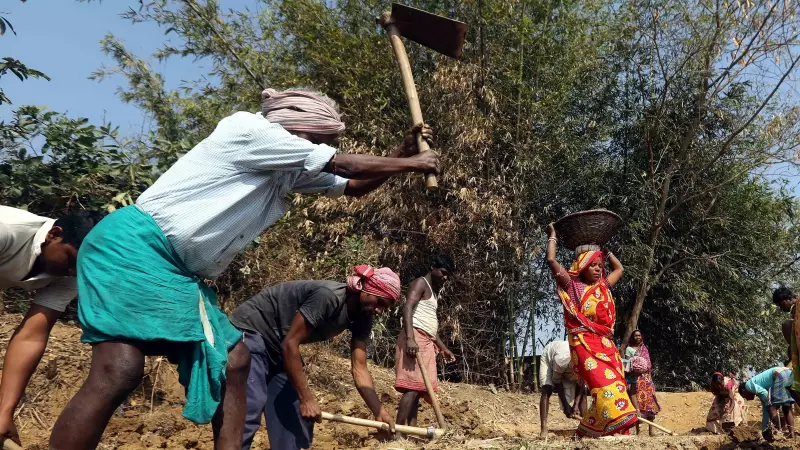
The BJP-led NDA government has ushered in a significant overhaul of India's rural employment guarantee framework by enacting the Viksit Bharat-Guarantee for Rozgar and Ajeevika Mission (Gramin) Act, 2025, commonly called the G Ram G Act. This new legislation, passed by voice vote in Parliament's Winter Session amid opposition protests, repeals the two-decade-old Mahatma Gandhi National Rural Employment Guarantee Act (MGNREGA).
A Fundamental Shift in Funding and Framework
The G Ram G Act introduces a Centrally Sponsored Scheme for unskilled rural jobs but marks a stark departure from MGNREGA's financial architecture. The most contentious change is the revised fund-sharing pattern between the Centre and states. Under MGNREGA, the Centre bore 100% of wage costs and 75% of material and administrative expenses. On average, the Centre funded about 90% of the total scheme cost.
The new Act, under Section 22, mandates a 60:40 (Centre:State) sharing ratio for most major states, including Uttar Pradesh, Bihar, Maharashtra, Tamil Nadu, and Rajasthan. For the 11 Northeastern and hilly states, the ratio is 90:10. Only Union Territories without legislatures will receive full central funding.

This shift places a substantially higher fiscal burden on states. Based on the Union Rural Development Ministry's estimate of an annual outlay of Rs 1,51,282 crore for the new scheme, the states' collective share would be approximately Rs 55,589.69 crore. Analysis of the previous year's MGNREGA expenditure suggests this could translate to an additional annual burden of over Rs 30,000 crore for state exchequers, a significant strain for many already facing financial constraints.
Key Challenges and Contentious Provisions
Beyond funding, the Act introduces other provisions that may complicate its rollout and effectiveness.
The "Normative Allocation" Model: Section 4(5) of the Act replaces MGNREGA's bottom-up, demand-driven labour budgeting process. Now, the Central Government will determine state-wise annual allocations based on "objective parameters" it prescribes. This top-down approach could disadvantage states with historically high demand for work, such as Tamil Nadu, Uttar Pradesh, Rajasthan, Bihar, and Andhra Pradesh, which together accounted for a major share of MGNREGA beneficiaries.
The 60-Day Pause: A novel feature is the provision for a state-notified 60-day pause during sowing and harvesting seasons to ensure farm labour availability. While addressing agricultural sector concerns, this effectively reduces the window to avail of the scheme's guaranteed 125 workdays (up from MGNREGA's 100 days). Given India's diverse agro-climatic calendars, synchronizing this pause nationally will be complex.
Higher Administrative Costs: Union Minister Shivraj Singh Chouhan indicated the scheme's administrative expenditure is pegged at 9% of the total outlay, higher than MGNREGA's 6% and significantly above the average 2.5% for most government schemes.
The Road Ahead: Implementation Hurdles and Fiscal Impact
The transition from MGNREGA to the G Ram G scheme is set for a bumpy road. The Centre must first clear all pending liabilities under the old act. States have a six-month window to implement the new law, likely leading to staggered rollouts across the country.
The combined effect of the increased financial share for states, the normative allocation system, and the seasonal pause will fundamentally alter how rural employment guarantee is accessed and delivered. The success of the VB-G RAM G Act will hinge on seamless coordination between the Centre and states, timely fund flows, and careful management of the agricultural pause to avoid depriving needy households of work. Its long-term performance and its impact on rural livelihoods remain to be seen as it moves from statute to implementation.