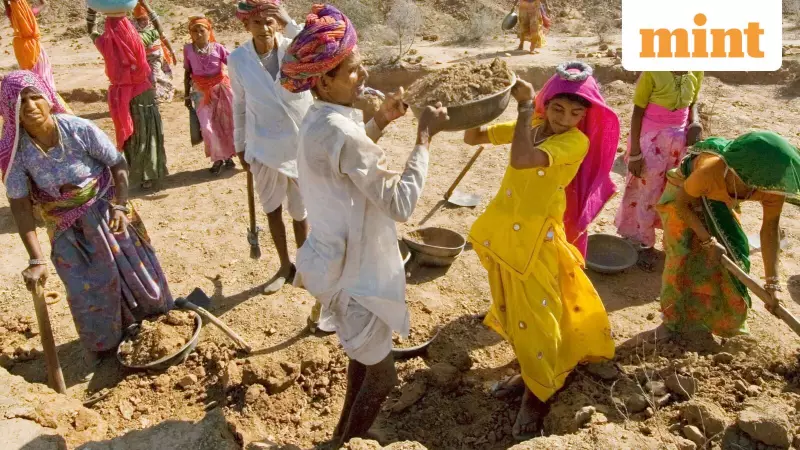
India's Parliament has enacted a significant overhaul of its rural employment policy, repealing the two-decade-old Mahatma Gandhi National Rural Employment Guarantee Act (MGNREGA). In its place, lawmakers passed the Viksit Bharat—Guarantee for Rozgar and Ajeevika Mission (Gramin) Act, known as VB-G RAM G, marking a fundamental shift in the nation's approach to livelihood security for its rural poor.
From a Legal Right to a Conditional Scheme
The original MGNREGA, established in 2005, was celebrated for its rights-based and justiciable framework. It guaranteed up to 100 days of wage employment per rural household annually, a provision that could be legally demanded. This unconditional nature made it a critical social safety net. The program is widely credited with improving rural infrastructure, boosting agricultural productivity, and reducing poverty, especially during the COVID-19 pandemic when it supported returning migrants.
The new VB-G RAM G Act dismantles this core principle. It removes the universal right to demand work. Instead, funding allocations will be determined by the central government based on its own objectives. Furthermore, the Act introduces a provision to suspend the guarantee for an aggregate of 60 days during peak agricultural seasons. While demand for MGNREGA work is typically low during these periods, its mere availability historically empowered laborers to negotiate better market wages.

Financial Burden Shifts and Potential Consequences
The financial architecture of the scheme has also been radically altered. Under MGNREGA, the central government bore approximately 90% of the costs. The new law stipulates that the Centre will fund only 60% of the costs for large states, placing a heavier fiscal burden on state governments. This change is expected to disproportionately penalize poorer states with weaker fiscal capacities, potentially exacerbating inter-state inequality.
Economists warn that these changes could have severe repercussions for the rural economy. By removing the legally-backed guarantee and suspending it during peak seasons, the new Act may exert downward pressure on market wages. This comes at a time when agricultural wage growth has stagnated and real non-farm wages have been declining. The promise of increasing the guaranteed workdays from 100 to 125 offers little comfort, as data shows the average days utilized historically remained below 50, with very few households reaching the maximum limit.
An Eroding Lifeline for the Marginalized
MGNREGA served as a crucial lifeline, particularly for women and marginalized communities, accounting for almost one-third of rural households. It acted as a cushion during droughts, policy shocks, and lean agricultural periods. The dilution of this foundational security, experts argue, risks slowing India's rural economic revival and increasing distress. The shift from a universal right to a conditional, objective-based allocation represents a profound policy transformation whose impact will be closely watched in the coming years.