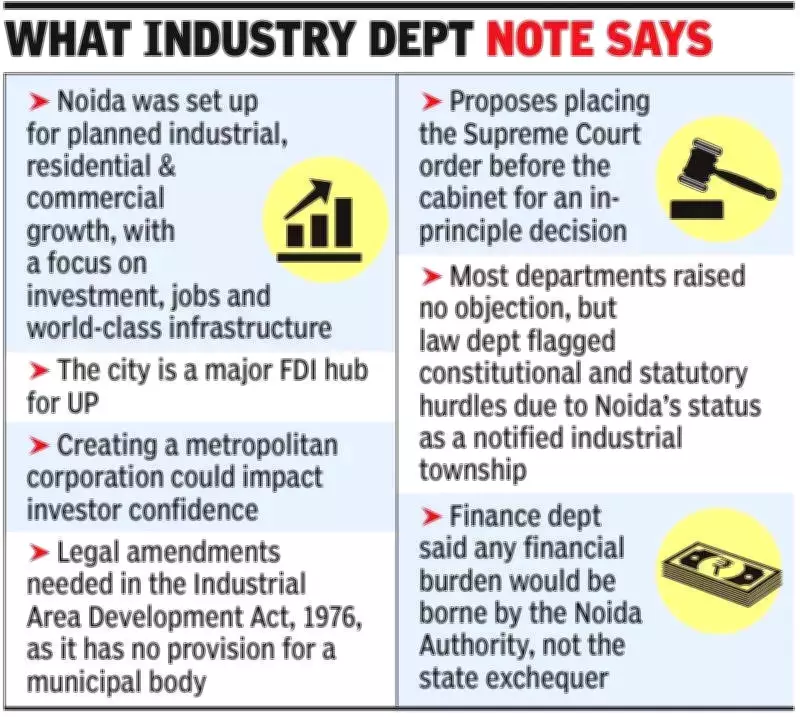
The Uttar Pradesh industries department has taken a significant step toward transforming Noida's governance structure by preparing a detailed note proposing the creation of a metropolitan corporation in the city. This proposal is now slated for consideration by the state council of ministers, marking a potential shift in how the National Capital Region city is administered.
Current Governance Framework and Proposed Changes
Noida currently operates under the New Okhla Industrial Development Authority, commonly known as Noida Authority, which was established in 1976 under the Uttar Pradesh Industrial Area Development Act. As an industrial township, Noida lacks a municipal corporation, with all notified areas being governed exclusively by the Noida Authority. The proposed metropolitan corporation would represent a fundamental structural change, introducing elected representation and potentially altering decision-making processes.
Supreme Court Directive and SIT Recommendations
The industries department's note follows a Supreme Court order issued in August last year, which directed the Uttar Pradesh chief secretary to present the proposal for converting Noida into a metropolitan body before the council of ministers. This judicial intervention was based on recommendations from a state-appointed Special Investigation Team that was investigating a land compensation scam involving Noida Authority.

The SIT report sharply criticized the existing governance model, highlighting several systemic issues:
- Decision-making concentrated among a limited number of officials
- Inadequate oversight mechanisms and weak accountability structures
- Land allotment policies that appeared to favor certain builders
- Lack of transparency and insufficient public scrutiny of decisions
- Twenty cases of excess compensation payments totaling approximately Rs 118 crore to landowners
Departmental Concerns and Constitutional Considerations
While advocating for greater transparency and citizen involvement, the industries department expressed concerns about potential impacts on investor confidence, noting Noida's crucial role as a major hub for foreign direct investment in Uttar Pradesh. The department emphasized that Noida was originally established to ensure planned industrial, residential, and commercial growth while attracting investment, promoting entrepreneurship, generating employment, and developing world-class infrastructure.
The proposal faces constitutional and statutory challenges, as highlighted by the law department. Under Article 243Q of the Constitution, municipalities are not mandatory in notified industrial townships, and specific provisions bar the formation of municipalities in such areas. Additionally, Section 12-A of the 1976 Act, amended in 2001, prohibits panchayats in industrial townships. The Industrial Area Development Act contains no provisions for establishing a civic body, meaning implementing the Supreme Court's directions would require legislative amendments.
Interdepartmental Consultation and Financial Implications
Most consulted departments, including urban development, revenue, planning, and housing, reportedly recorded no major objections and left the final policy decision to the cabinet. The finance department clarified that any costs associated with forming a metropolitan corporation would be borne by Noida Authority, with no financial liability falling on the state exchequer.
SIT's Vision for Improved Governance
The SIT report argued that rapid urbanization and the depletion of Noida's land bank necessitate a fundamental overhaul of the city's governance and urban management model. The proposed metropolitan corporation could address day-to-day service deficiencies in areas such as waste management, public transport, and local infrastructure maintenance.
The SIT specifically suggested that a corporation could be structured to incorporate elected ward representatives, ensuring local voices are heard and represented in decision-making processes. For instance, each sector could elect a council member responsible for advocating for constituents' needs and concerns, thereby fostering greater accountability and responsiveness in governance.

Path Forward and Ministerial Approval
After reviewing the SIT report and departmental feedback, Industrial Development Minister Nand Gopal Gupta Nandi approved the note for the council of ministers' consideration. The department recommended that ministers be formally apprised of the Supreme Court's order to take an in-principle decision on constituting a metropolitan corporation in Noida, with the stated goals of bringing transparency and increasing citizen involvement in decision-making processes.
The Supreme Court bench, comprising Justices Surya Kant and Joymalya Bagchi, acknowledged that implementing the SIT recommendations would require various policy decisions, including the formation of a metropolitan corporation. The court emphasized the need to infuse transparency and a citizen-centric approach into Noida's day-to-day functioning, directing that the proposal be placed before the council of ministers for appropriate decision-making.