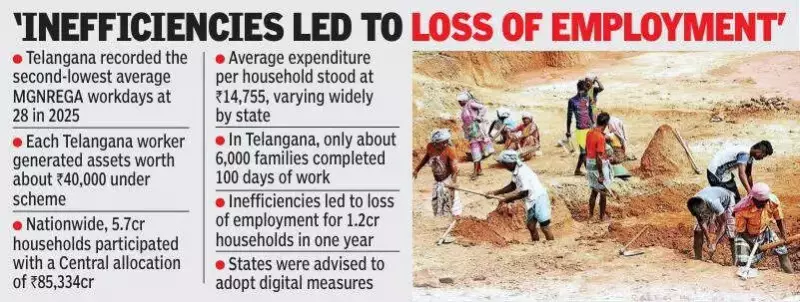
New data has revealed a concerning performance of Telangana in the implementation of the rural jobs guarantee scheme, now rebranded as the Viksit Bharat Guarantee for Rozgar and Ajeevika Mission (Gramin). The state recorded the second-lowest average number of workdays provided to households across India in 2025, becoming a focal point in the ongoing discourse about the scheme's efficiency.
Low Workdays and Asset Creation in Telangana
According to an analysis of available data, Telangana provided an average of just 28 workdays to households under the scheme in 2025. Only Uttarakhand performed worse, with an average of 27 days. Assam also featured among the low-performing states with 31 average workdays. Despite the low number of days, it is estimated that each person employed under the scheme in Telangana generated assets worth approximately Rs 40,000.
In Telangana, around 20 lakh households participated in the programme. Of these participants, nearly 1.8 lakh were women workers. However, a very small fraction, only about 6,000 families, managed to secure the full 100 days of work guaranteed by the law during the entire year.

National Picture: High Allocation, Mixed Results
Nationally, the scheme saw participation from about 5.78 crore households, supported by a substantial Central allocation of Rs 85,334 crore. This translated to an average expenditure of Rs 14,755 per household, though the spending varied widely from state to state.
The analysis, which covered 18 major states accounting for 5.46 crore households, uncovered significant inefficiencies. A comparison with four better-performing states showed that with the same Central allocation, employment could have been provided to 6.64 crore households. Instead, due to structural weaknesses, fund misappropriation, and other inefficiencies, an estimated 1.22 crore households lost out on potential employment in a single fiscal year.
Push for Transparency and Tech-Driven Solutions
In response to these findings and in line with the objectives of the new Act, states have been urged to adopt a series of innovative measures to boost efficiency and accountability. The recommended steps include:
- Implementing biometric authentication systems for secure worker identity verification.
- Using spatial and geotagging technology for more effective project planning and monitoring.
- Establishing robust digital monitoring mechanisms to track progress and outcomes in real-time.
Furthermore, states are encouraged to make weekly public disclosures of scheme data to keep citizens informed and to strengthen social audit processes to enhance public trust and curb malpractice. These measures aim to ensure that the vital rural employment guarantee reaches its intended beneficiaries more effectively.