PM Surya Ghar Yojana Faces Hurdles in Telangana as Rooftop Solar Adoption Lags
The PM Surya Ghar: Muft Bijli Yojana, a central government initiative launched in February 2024 to boost rooftop solar installations across India, is struggling to gain traction in Telangana. Since its inception, the state has managed a mere 32,600 installations, a figure that pales in comparison to neighboring Andhra Pradesh, which has surpassed 1.1 lakh installations, and leading states like Gujarat and Uttar Pradesh, each exceeding four lakh installations. This significant gap highlights underlying challenges in policy implementation and on-ground realities.
Policy and Structural Barriers Impede Progress
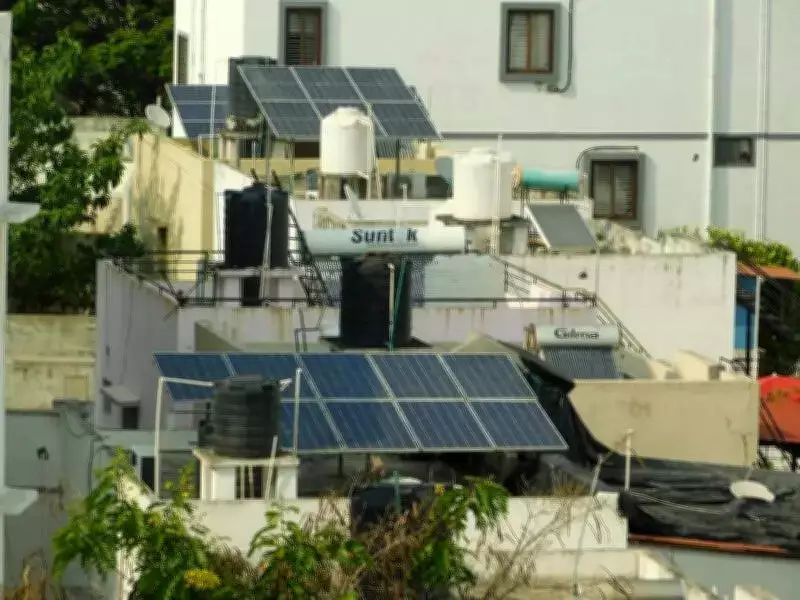
Stakeholders point to a combination of regulatory limitations and practical constraints as the primary drag on solar adoption. A major obstacle lies in apartment complexes and gated communities, where rooftops are shared assets rather than individually owned. This creates both regulatory and practical difficulties for solar installations.
Dr Sai Ravi Shankar, president of the Federation of Gated Communities in Cyberabad, explained, "Solar adoption in apartments is largely confined to common utilities such as lifts, lighting, and water pumps. Individual households face resistance because terraces are common property. For personal use, systems must link to each flat's meter, requiring separate panels—an arrangement that is neither practical nor typically permitted by Resident Welfare Associations (RWAs)."

Telangana's current policy framework exacerbates these issues by allowing only individual homeowners to install solar systems and benefit from net metering, where excess power is fed back to the grid for bill credits. Srinivas Murthy, chairperson of the Indian Green Building Council's Hyderabad chapter, noted, "Developers cannot implement solar at a community level unless ownership is transferred to buyers, making large-scale projects commercially unviable. This results in partial adoption even in major housing developments."
Infrastructure and Awareness Gaps Further Slow Adoption
Beyond policy, infrastructure readiness and awareness remain critical concerns. Murthy highlighted that Telangana's surplus power reduces the urgency for solar adoption, and the grid may struggle to absorb additional power from large private solar plants. He emphasized, "A coordinated approach involving distribution companies (discoms), government bodies, RWAs, and industry stakeholders is essential for scaling rooftop solar effectively."
Grid upgrades and clear directives are needed to prevent strain on the system, especially from private producers. Additionally, a lack of government push and limited awareness about long-term savings continue to hinder progress, despite available subsidies.
Independent Houses Drive Residential Solar Demand
In contrast to apartment complexes, independent houses are witnessing steady growth in solar adoption. Data from Freyr Energy indicates that the residential segment now accounts for 50% to 60% of new solar demand in Telangana. Commercial establishments contribute 25% to 30%, while industrial installations make up 10% to 15%, albeit with larger system sizes.
This surge is fueled by central subsidies and increasing awareness of cost savings. Most installations range from 3 kW to 5 kW, tailored to household consumption and rooftop space. A 3 kW system is common for smaller homes, while 5 kW systems are preferred in higher-consumption households.
Financing and Savings Make Solar Accessible for Homes
Financing has emerged as a key enabler for individual houses. BT Srinivas, general secretary of the United Federation of Resident Welfare Associations, stated, "Solar adoption is picking up because banks are financing the upfront cost after subsidies. A typical 3 kW system costs around Rs 1.25 lakh, with about Rs 50,000 covered through subsidy. The remaining amount can be financed, reducing the initial burden."

He added that in many cases, loan repayments are offset by electricity bill savings, making it a near-zero-investment option within five years. Savings are substantial: a 3 kW system generates approximately 15 units per day, cutting bills to Rs 1,800–2,000 in summer with AC usage and Rs 200–500 in other seasons. During monsoon and winter, generation may drop to about 5 units daily, but lower consumption balances the impact.
Free Electricity Scheme Dampens Incentive for Solar Switch
According to the Telangana Renewable Energy Development Corporation Ltd (TGREDCO), the state's provision of 200 units of free electricity reduces the immediate incentive for households to adopt solar power. Anila V, managing director of TGREDCO, noted, "However, we have initiated the Pradhan Mantri Kisan Urja Suraksha evam Utthaan Mahabhiyan (PM-KUSUM) scheme in Telangana, along with subsidies, which are yielding results."
Under PM-KUSUM, the government aims to establish 4,000 MW of decentralized, ground-mounted, grid-connected solar power plants on barren or agricultural land. So far, around 1,100 farmers have benefited, and efforts are underway to raise awareness and encourage broader residential adoption.
Future Prospects and Recommendations for Scaling Solar
To address gaps in apartment complexes, policy innovation is crucial. Radhika Choudary, co-founder and director of Freyr Energy, suggested, "Adoption can scale through shared models like group or virtual net metering, allowing solar power from a shared rooftop to be distributed across multiple flats, bypassing ownership constraints. Simplified approvals, stronger RWA awareness, and incentives for larger systems can make apartments viable."
Subrahmanyam Pulipaka, CEO of the National Solar Energy Federation of India, observed that Telangana has historically been slower in rooftop solar adoption, but demand exists, especially in smaller towns and independent homes. He emphasized, "Awareness and policy push remain the bigger gaps. Discoms must play a more proactive role by engaging directly with consumers, as seen in states like Uttar Pradesh, where stronger DISCOM involvement has driven higher adoption."
Despite procedural delays and hesitation around upfront costs, the potential for growth remains significant if these challenges are addressed through collaborative efforts and targeted initiatives.