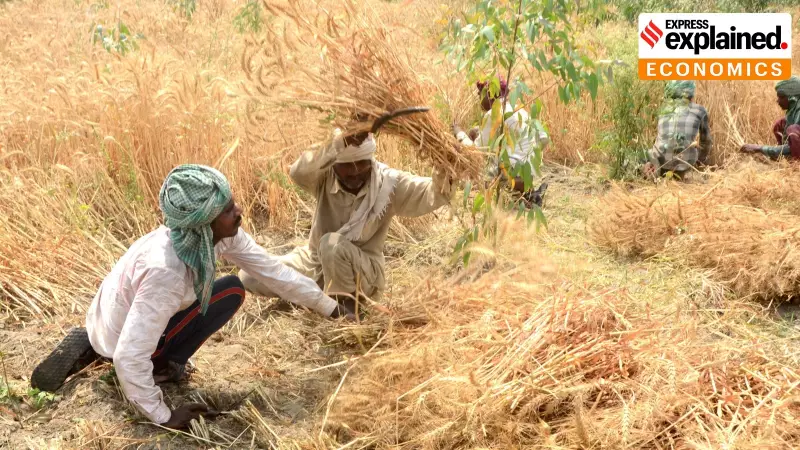
The Narendra Modi government's proposed Viksit Bharat-Guarantee for Rozgar and Ajeevika Mission Gramin (VB-G RAM G) Bill, introduced in Parliament on Tuesday, contains a significant provision aimed at India's agricultural heartland. The bill seeks to restrict rural employment generation works for up to 60 days each financial year during the critical peak seasons of sowing and harvesting. This move is explicitly designed to ensure adequate availability of farm labour when it is needed most.
The Core Debate: Did MGNREGA Drain Farm Labour?
The VB-G RAM G Bill intends to replace the existing Mahatma Gandhi National Rural Employment Guarantee Act (MGNREGA) of 2005. For years, critics of MGNREGA, including former Union Agriculture Minister Sharad Pawar, have argued that the scheme created acute labour shortages on farms. Pawar had even written to the then Prime Minister Manmohan Singh, advocating for a three-month pause in MGNREGA during agricultural peaks. The new bill's provision for a two-month break revives this long-standing debate.
Proponents of the pause believe MGNREGA tightened the rural labour market, increasing the bargaining power of workers and making it harder for farmers to find hands during crucial periods. However, a decade's worth of wage data paints a more nuanced picture, challenging the assumption of a severe labour crunch driven solely by the employment guarantee scheme.

What the Rural Wage Data Reveals
An analysis of rural wage growth over the ten years ending 2024-25, based on Labour Bureau data from 600 villages across 20 states, shows a tepid trend. The year-on-year growth in all-India average rural wages for male labourers ranged between 3.6% and 6.4%. Crucially, in four of those ten years, nominal wage growth fell behind consumer price inflation, meaning real wages actually declined.
Interestingly, agricultural wages grew faster than overall rural wages in eight out of the ten years. The Labour Bureau tracks 12 specific farm occupations, from ploughing to harvesting and fishing. Despite this relative outperformance, the growth in nominal farm wages has largely only kept pace with inflation, showing no evidence of a dramatic, MGNREGA-fuelled surge that would indicate a severe shortage of workers.
The Female Workforce: A Key Factor in Wage Trends
One compelling explanation for the subdued rural wage growth lies in the changing demographics of the labour force itself. The Labour Force Participation Rate (LFPR) for women in rural India has seen a remarkable and sustained increase. The LFPR measures the percentage of the population aged 15 and above that is working or actively seeking work.
Official Periodic Labour Force Survey data shows the all-India rural female LFPR jumped from a mere 24.6% in 2017-18 to 47.6% in 2023-24. The government's Economic Survey for 2023-24 credited flagship schemes like Ujjwala, Har Ghar Jal, and Swachh Bharat for this shift. By providing access to LPG, piped water, and toilets, these initiatives freed women from time-consuming domestic chores like collecting firewood and fetching water.
This liberation of women's time has led to a "rightward shift of the labour supply curve" in economic terms. Simply put, a significantly larger number of women are now available for work. This expansion of the workforce supply has exerted a natural downward pressure on wage growth, as more people are willing to work, potentially offsetting any labour pull from MGNREGA projects.
Conclusion: A Complex Picture Beyond Simple Narratives
The evidence suggesting MGNREGA caused an all-encompassing farm labour shortage appears weak. While farmers may genuinely face challenges in hiring labour for time-sensitive tasks like paddy transplanting or cotton picking, the data does not conclusively pin the blame on the rural jobs scheme. The massive influx of rural women into the workforce has likely played a more substantial role in shaping wage dynamics and labour availability.

The proposed 60-day pause in the VB-G RAM G Bill addresses a perceived problem. However, whether such a blanket restriction is justified, or if more targeted, evidence-based solutions are needed, remains a question for further ground-level investigation. The interplay between social welfare, agricultural productivity, and women's economic empowerment continues to define India's rural economic landscape.