

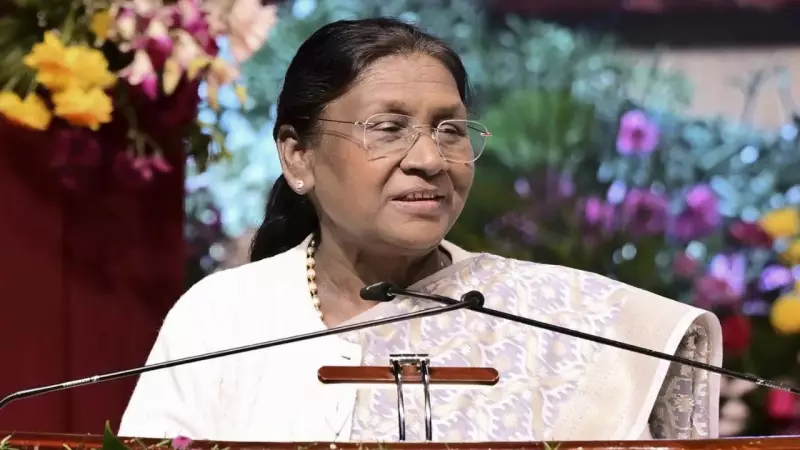
In a landmark move that reshapes India's rural employment landscape, President Droupadi Murmu on Sunday granted her assent to a new legislation, effectively replacing the long-standing Mahatma Gandhi National Rural Employment Guarantee Act (MGNREGA). The Viksit Bharat - Guarantee for Rozgar and Ajeevika Mission (Gramin) Bill, 2025 has now been enacted into law following the presidential nod.
From Bill to Act: The New Legal Framework
The presidential assent transforms the bill into the VB-G RAM G Act, 2025. An official notification confirming this development was published in the Gazette of India on December 21. The new law marks a significant policy shift, moving away from the UPA-era MGNREGA framework that has been in place since 2005.
The core objective of the Act, as stated in the notification, is to establish a rural development framework aligned with the national vision of Viksit Bharat@2047. It does this by providing a statutory guarantee of not less than 125 days of wage employment per rural household in each financial year. This guarantee is available to households whose adult members volunteer for unskilled manual work.

Enhanced Entitlements and Ministerial Defense
The Ministry of Rural Development highlighted that the increase from the earlier 100-day entitlement under MGNREGA to 125 days is a crucial enhancement. The ministry stated that this change strengthens livelihood security, predictability of work, and income stability for millions of rural households across the country.
The passage of the bill in Parliament was met with protests from opposition parties, who have demanded its withdrawal. In response, Rural Development Minister Shivraj Singh Chouhan addressed the nation through a video message on Sunday. He accused opponents of orchestrating a conspiracy to mislead the public in the name of MGNREGA.
"Once again, a conspiracy is underway to mislead the country in the name of MGNREGA," Chouhan asserted. He firmly stated that the VB-G RAM G scheme is designed in favour of the poor and provides a complete guarantee of employment to workers.
Funding and Administrative Provisions
Taking to social media platform X, Minister Chouhan elaborated on the scheme's financial backing and structural improvements. He countered claims of misinformation, stating, "Misinformation is being spread, whereas the truth is that the new scheme is beyond MGNREGA."
He revealed that a massive allocation of over Rs 1,51,282 crore has been proposed for the scheme this very year to ensure sufficient funds for employment generation. A key administrative reform in the new Act is the increase in the provision for administrative expenses from 6% to 9% of the total outlay.
Chouhan explained the benefit of this increase: "If we take out 9% from the proposed amount of Rs 1.51 lakh crore, it comes to Rs 13,000 crore; with this amount, all those who get the work done will receive timely and adequate salaries, so that they can carry out the work with full capacity." This, he argued, would lead to more efficient implementation and better outcomes for workers on the ground.
The enactment of the VB-G RAM G Act, 2025, concludes a significant legislative process and sets the stage for a new era in India's approach to rural employment and poverty alleviation, squarely aiming to support the national goal of a developed India by 2047.






