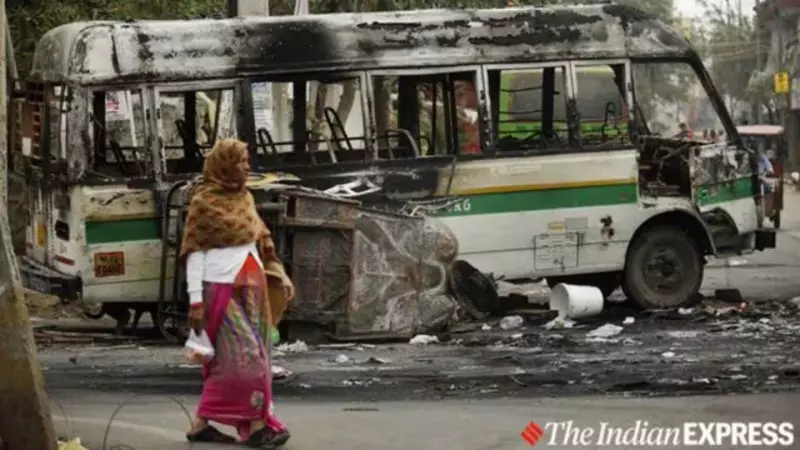
The Supreme Court heard sharp arguments on Tuesday from lawyers representing accused in the larger conspiracy case related to the 2020 Delhi riots, with the defence terming the police's allegation of an attempt at 'regime change' as "extraordinary" and unprecedented.
'Regime Change' Allegation: A New and Prejudicial Claim
Countering the Delhi Police's charge that the 2020 riots, which resulted in 53 deaths, were aimed at orchestrating a regime change in India, the accused argued this claim was never part of the original legal argument. Appearing for accused Gulfisha Fatima, senior advocate A M Singhvi told a bench of Justices Aravind Kumar and N V Anjaria that this aspect was being raised now to prejudice the court.
"The allegation of regime change is quite extraordinary. Where have you alleged regime change as the heart of your chargesheet?" Singhvi questioned. He pointed out that the police claim it was a pan-India conspiracy to separate Assam from India but asked for the basis of such a claim. He emphasised that the regime change argument was never argued in the High Court or the trial court and was suddenly introduced to make the case sound more serious.

Prolonged Incarceration and Continuous Chargesheets
Singhvi further submitted that the police were continuously filing supplementary chargesheets to prolong the detention of the accused. "I have been in jail for just under six years," he stated on behalf of Fatima. He noted that a chargesheet was filed on September 16, 2020, but since then, the filing of supplementary chargesheets had become a ritual, with four supplementary and one main chargesheet submitted so far.
He described the delay in the trial as "sad, astonishing and unprecedented," given the arrest was in 2020. Singhvi highlighted that Gulfisha Fatima is "the only lady under incarceration" still, as others got bail in 2021, and argued her case was much lesser. Seeking bail, he questioned the public interest in keeping her jailed, suggesting alternatives like ankle monitors and GPS tracking used in other countries.
Umar Khalid's Defence: No Link Between Speech and Riots
Senior advocate Kapil Sibal, appearing for another accused, Umar Khalid, challenged the police's claim that Khalid instigated the rioters, arguing they had no evidence to back it. The court pointed out that the chargesheet alleged his speeches led to the riots and the subsequent deaths.
Sibal countered that the speech being cited was delivered on February 17 in Amaravati, Maharashtra, while the riots occurred in Delhi on February 23, 24, and 25. "I was not even here," he stated on Khalid's behalf. He played the Amaravati speech in court, where Khalid was heard advocating Gandhian ways of protest.
"An academician in an institution, what can he do to overthrow a country or state?" Sibal asked. He contended that the High Court had relied on this speech to find a prima facie case of an inflammatory speech, but a full reading revealed nothing about inciting communal riots. He argued that others who allegedly made inciting remarks were either not booked or were on bail, while Khalid, who sent no messages, was an accused simply for being added to a WhatsApp group.
Sharjeel Imam Labeled 'Intellectual Terrorist'
The prosecution had earlier played videos of accused Sharjeel Imam's speeches during the anti-CAA protests, where he allegedly spoke of cutting off Assam. Opposing bail, they stated that "intellectuals when they guide and become terrorists, they become more dangerous."
Responding to this, senior advocate Siddharth Dave, appearing for Imam, said this tag caused "deep anguish" and violated the presumption of innocence. "I am not a terrorist as I have been called by the respondent. I am not an anti-national... I am a citizen of this country by birth," Dave asserted. He argued that Imam was already being prosecuted for the speeches police were citing, questioning how the same speeches could form the basis for a separate conspiracy FIR.
The hearings underscore the intense legal battle surrounding the 2020 Delhi riots conspiracy case, with the defence challenging the foundational claims of the prosecution and raising serious concerns about the pace and nature of the proceedings.