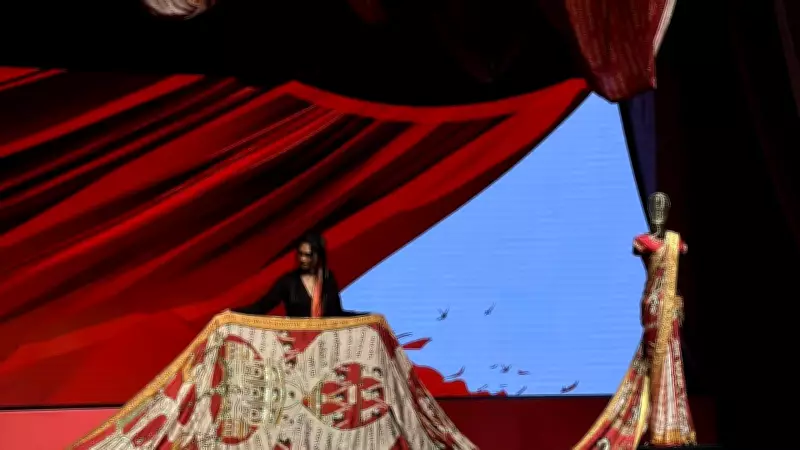
Visitors to the 26th edition of the Kala Ghoda Arts Festival in South Mumbai, which commenced on Saturday, are witnessing a remarkable and thought-provoking installation: a four-kilometre-long saree gracefully unfurling across the courtyard of Elphinstone College. This extraordinary garment, known as the Infinite Saree, serves not merely as an artistic display but as a powerful, living petition challenging India's contentious marital rape laws. Adorned with thousands of signatures, embroidered messages, and urgent legal demands, it represents a bold campaign for gender justice and legal reform.
A Campaign Born from Legal Injustice
First unveiled on Wednesday at Mumbai's historic Royal Opera House, the Infinite Saree is the latest initiative by the Red Dot Foundation, a United Nations-accredited nonprofit organization dedicated to documenting and addressing gender-based violence across India. Although the foundation has been active in this critical space for over a decade, the campaign gained immediate urgency following a distressing legal development in 2025.
Supreet K Singh, filmmaker and co-founder and CEO of Red Dot Foundation, explained the catalyst. "Last year, there was a tragic case where a man sexually assaulted his wife, including forced and unnatural intercourse, which ultimately led to her death. Shockingly, the court acquitted him due to the marital rape exception embedded in Indian law. This verdict compelled us to take decisive action," she stated. Singh was referring to a February 2025 ruling by the Chhattisgarh High Court, which overturned the conviction of a 40-year-old man found guilty by a trial court in 2019 of raping and committing unnatural sex with his wife, who died hours after the alleged assault.
The Saree as a Symbol of Strength and Silence
"That's when the concept of the Infinite Saree truly took shape. A saree is intimate, familiar, and deeply intertwined with womanhood in our nation," Singh elaborated. "It symbolizes both strength and resilience, yet also reflects the burdens women are often expected to bear in silence." To bring this vision to life, she collaborated with renowned fashion designer Nivedita Saboo. Together, they meticulously designed a four-kilometre-long saree, setting a new world record by surpassing the previous Guinness World Record of 3.7 kilometres.
"Our intention was to create the longest living petition, shaped like a woman's traditional attire, as a direct response to that pervasive silence," Singh emphasized. The fabric itself functions as a public archive, with printed and embroidered elements featuring petitioner signatures and poignant phrases such as "This is not right", "My rights are human rights", and "Consent does not end at marriage". Embedded QR codes guide viewers to an online petition that has already amassed over 5,400 signatures, with an ambitious goal of reaching 50,000 by the end of March, when Singh plans to formally present the petition to the judiciary.
Amplifying Voices at Kala Ghoda
The installation at the Kala Ghoda Arts Festival, which will remain on display until February 8, is strategically positioned to maximize impact. With festival footfalls anticipated to reach nearly 10 lakh, organizers aim to engage diverse audiences beyond policy circles, including students, families, tourists, and first-time attendees. At the Royal Opera House unveiling, where the saree enveloped the building in a continuous stretch, visitors paused to read the embroidered pallu, sparking conversations many still hesitate to voice aloud.
Singh shared moving anecdotes from the event. "One particularly memorable moment was when the mother of a trans man approached to thank me; you could sense she carried her own untold story. Another was a father who brought his daughters and declared, 'I want the law to see them equally.' These were individuals from South Bombay—privileged and influential—who had never previously spoken out on this issue," she recounted.
Engaging Broader Audiences and Allies
"Not everyone feels comfortable lending their voice to sensitive issues like marital rape," Singh acknowledged. "However, visibility fosters conversation, and conversation generates the necessary pressure for change." To broaden the campaign's reach, the Red Dot Foundation has enlisted actor Rahul Bhatt as its brand ambassador. "Involving a male campaign ambassador is crucial to bringing the other half—men—into this dialogue," Singh noted, recalling Bhatt's remarks at the unveiling about how men often retreat into silence, a behavior that must be transformed.
A Legacy of Data-Driven Advocacy
The Red Dot Foundation's work is rooted in data-driven advocacy for systemic change. Established in the aftermath of the horrific 2012 Nirbhaya case, the organization launched Safe City, an anonymous reporting platform for sexual violence in public spaces, and formally registered as an NGO in 2014. During the Covid-19 lockdowns, the foundation expanded its focus to domestic violence, responding to a surge in distress calls from women trapped in abusive households.
As the Infinite Saree continues to unfurl in Mumbai, it stands as a testament to the power of creative protest and collective action. By intertwining tradition with activism, this campaign not only challenges outdated legal frameworks but also ignites essential conversations about consent, equality, and justice in contemporary India.