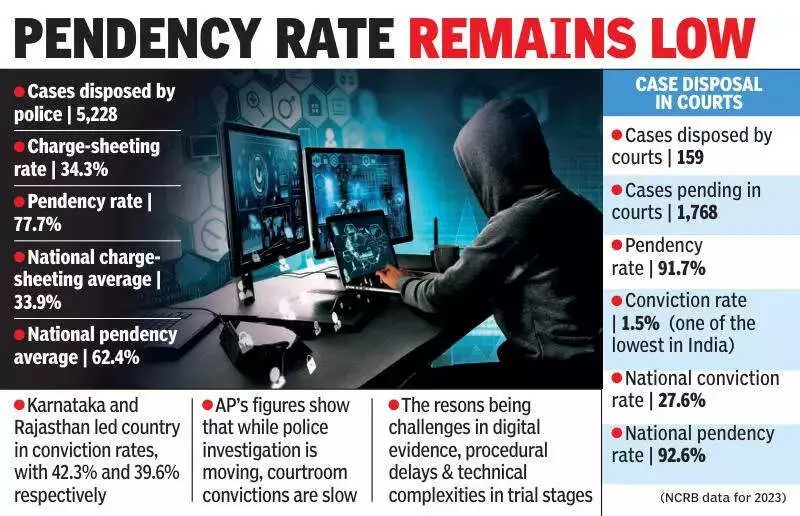
In Andhra Pradesh, a significant gap exists between the efficiency of police investigations and the pace of the judicial system in handling cybercrime cases. This pattern, revealed by the latest National Crime Records Bureau (NCRB) data for 2023, reflects a nationwide crisis where law enforcement moves faster than the courts can deliver verdicts.
Police Show Proactive Stance in Cybercrime Investigations
According to the 'Crime in India' report, the Andhra Pradesh police disposed of a total of 5,228 cybercrime cases in 2023. The state achieved a charge-sheeting rate of 34.3%, which is close to the national average of 33.9%. However, the pendency rate at the police level remained high at 77.7%, indicating a substantial backlog despite active efforts.
This performance places Andhra Pradesh among the mid-performing states in terms of police disposal efficiency. For context, states like Madhya Pradesh led with a remarkable 93.7% charge-sheeting rate, followed by Bihar (82.7%) and Chhattisgarh (84.4%). On the lower end, Karnataka and Assam recorded rates around 18%.

The consistent registration and movement of cases to court in AP suggest a functional and active cybercrime investigation mechanism, bolstered by the growing network of dedicated cyber crime police stations across its districts.
Courtroom Bottlenecks: Sky-High Pendency, Abysmal Conviction
The scenario changes dramatically once cyber cases enter the judicial system. The NCRB data paints a grim picture for the state's courts. In 2023, Andhra Pradesh courts completed trials in only 132 cases and disposed of 159 cases. A staggering 1,768 cases remained pending, resulting in an overwhelming pendency rate of 91.7%.
More critically, the conviction rate stood at just 1.5%, ranking among the lowest in the country. This is in stark contrast to the national conviction average for cybercrimes, which was 27.6%. While the national pendency rate is also alarmingly high at 92.6%, AP's ability to secure convictions lags far behind the national standard.
States like Karnataka (42.3%) and Rajasthan (39.6%) demonstrated much higher conviction rates, with Bihar and Jharkhand also performing better in ensuring legal closure for cybercrime victims.
A National Crisis of Delay and Complexity
The Andhra Pradesh figures are a microcosm of a pan-India problem. Across the country, a total of 80,606 cybercrime cases were pending trial by the end of 2023. While courts disposed of 5,968 cases, convictions were secured in only 3,210, yielding the modest national conviction rate of 27.6%.
At the investigation stage, police nationwide handled over 1 lakh cases, with a pendency rate exceeding 62%. Officials attribute the delays at both police and judicial levels to the inherent complexity of cybercrimes. These cases often involve sophisticated crimes like phishing, OTP frauds, data theft, and online exploitation, requiring specialized digital forensics, interstate coordination, and expert testimony.
The trial stage, however, remains the most significant bottleneck. Challenges in presenting digital evidence, procedural delays, and the technical complexities of the legal process contribute to the slow crawl of cases through the judiciary, leaving victims in limbo and undermining the deterrent effect of the law.