

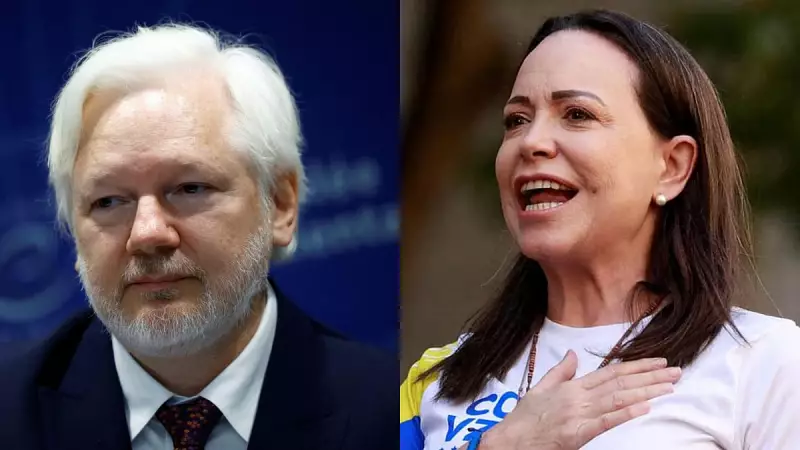
In a dramatic legal move that has captured international attention, WikiLeaks founder Julian Assange has initiated a lawsuit against the prestigious Nobel Foundation. The legal action, filed in a Stockholm district court, challenges the Foundation's decision to award the 2024 Nobel Peace Prize to Venezuelan opposition figure Maria Corina Machado.
The Core of the Legal Challenge
Julian Assange, who remains incarcerated in the United Kingdom while fighting extradition to the US, contends that the Nobel Foundation has violated its own foundational statutes. The lawsuit, officially filed on December 9, 2024, argues that the award to Machado breaches the Nobel will's directive to honour those who have "conferred the greatest benefit to humankind." Assange's legal team asserts that Machado's political career, which they characterise as supporting foreign interventions and sanctions against Venezuela, does not align with the spirit of fostering "fraternity between nations" or promoting peace.
The legal documents highlight a significant contradiction. They point out that Maria Corina Machado was awarded the prize on October 11, 2024, a date that coincides with the anniversary of a major US military operation. Assange's lawyers argue this timing and the selection undermine the prize's integrity. The lawsuit seeks a formal review of the decision-making process and potentially aims to have the award annulled, marking an unprecedented challenge to the Nobel Committee's authority.

Background: The Figures at the Heart of the Storm
To understand the suit, one must look at the profiles of the key individuals involved. Julian Assange, the Australian publisher, has been a polarising global figure for over a decade. His organisation, WikiLeaks, published vast troves of classified documents, leading to US charges under the Espionage Act. His supporters view him as a champion of press freedom, while critics accuse him of endangering lives. His legal battles have become a symbol of the struggle between state secrecy and public transparency.
On the other side is Maria Corina Machado, a veteran Venezuelan opposition leader. A former legislator, she is known for her fierce criticism of the governments of the late Hugo Chavez and his successor, Nicolas Maduro. The Nobel Committee recognised her "non-violent struggle for democratic freedoms and the right of the people to self-determination." However, her advocacy for strong international sanctions against Venezuela's oil industry and her past support for foreign political intervention have made her a controversial figure, both within Venezuela and internationally.
Global Repercussions and Political Undertones
This lawsuit transcends a simple legal dispute; it touches raw nerves in global geopolitics. Assange's action is seen by many observers as a direct challenge to Western institutional legitimacy. The case implicitly questions whether prestigious international awards can remain neutral or if they are influenced by broader political narratives. The response from the Nobel Foundation is awaited with bated breath, as any formal legal defence will require them to publicly justify their selection criteria and decision-making in a court of law.
The timing is also critical. Assange continues his final appeal against extradition from the UK to the US, where he faces a potential 175-year sentence. This lawsuit amplifies his profile as a critic of established power structures. Meanwhile, in Venezuela, the award to Machado has further polarised the political landscape, with the Maduro government condemning it as foreign interference. The legal proceedings in Stockholm will be closely watched by governments, human rights organisations, and media freedom advocates worldwide, as the outcome could set a remarkable precedent for holding award-granting bodies accountable.
Ultimately, this case pits two powerful narratives against each other: one of a publisher fighting a powerful state and challenging institutional hypocrisy, and another of a committee rewarding courageous activism in an authoritarian context. The Stockholm court's handling of this unique lawsuit will write a new chapter in the long and often contentious history of the Nobel Peace Prize.






