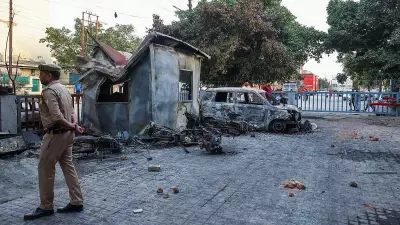
Bijapur District: The Persistent IED Epicenter of India
While Maoist forces have retreated further into the margins as security forces advance deeper into their former heartlands, they have left behind a deadly legacy hidden beneath the surface. The Bijapur district in Chhattisgarh's Bastar region, though no longer a Maoist stronghold, continues to serve as the country's primary epicenter for improvised explosive devices (IEDs). Despite significant reductions in armed Maoist formations and increasing surrender rates, this south Bastar district accounts for the overwhelming majority of IEDs being planted and recovered anywhere in India.
The Silent Threat Beneath the Surface
The gunfire may have diminished, but the ground itself remains weaponized. On Thursday, the Central Reserve Police Force (CRPF) recovered an IED weighing approximately 30 kilograms, strategically placed under a metal road on the Awapalli-Basaguda route. Located just three kilometers from the local police station, this device possessed sufficient power to destroy a Mine Protected Vehicle or a large bus. Police officials identified it as a command IED buried about two feet deep and connected to a 100-meter-long wire for manual detonation.
Although the CRPF bomb disposal team successfully defused the explosive during demining operations, concerns about buried explosives remain as high as during the peak insurgency period. Official CRPF data for 2025 reveals a stark pattern: of the 716 IEDs detected during nationwide demining procedures this year, 679 were recovered in Chhattisgarh, with 652 of those coming from Bijapur alone. During the last quarter (October–December), 101 IEDs were seized across India, with 92 found in Chhattisgarh, including 80 in Bijapur.

A Strategic Shift in Maoist Tactics
Security experts describe the surge in IED usage as a major strategic shift by Maoist cadres who have been pushed onto the defensive. "This is the biggest challenge now. These are weapons you don't see," explained a senior CRPF officer stationed in Bastar. "Earlier they relied on armed confrontation. While that space has shrunk, IEDs have now taken over as the primary weapon to deter advancing forces."
The state of Chhattisgarh accounted for 679 IED recoveries—nearly 95% of the national total—highlighting how the Maoist conflict has transformed from open gun battles to a buried war dominated by landmines. Security officials confirm that no other district in India comes close to such concentration of explosive devices.
Victim-Operated Devices: The Hidden Danger
Approximately 90% of recovered devices are classified as victim-operated IEDs (VOIs), triggered by pressure, pull, lift, or tilt mechanisms. Unlike command-detonated explosives, VOIs lie silently under forest tracks, culverts, and newly constructed roads—particularly those linked to road-opening parties and camp supply routes. The person who accidentally activates these devices becomes the victim.
Deputy Chief Minister Vijay Sharma, who also heads the Home Ministry, noted that recent recoveries and incidents indicate a fresh wave of underground explosive planting. Bastar Range Inspector General of Police P. Sundarraj acknowledged the persistent threat from IEDs, stating that Maoists heavily depend on these devices to mark their presence and inflict damage.
Technological Solutions and Ground Intelligence
Discussing potential solutions, Sundarraj explained, "While we use deep metal detectors to recover IEDs, top officials are exploring the possibility of advanced technology called GPR—ground penetration radar—which senses disturbances in soil and adds value to demining activity. This technology is used in select countries and border regions, but it needs to be tailor-made for Bastar's unique topography and dense jungle terrain."
The police officer highlighted that IED recoveries have increased significantly from 308 in 2024 to 894 in 2025, indicating strengthened ground intelligence, improved surveillance, and intensified area domination and search operations. This sharp rise suggests that numerous potential IED attacks were neutralized before causing damage.

The Human Cost and Material Reality
Most IEDs are locally assembled using readily available materials from mining zones, including gelatin sticks, urea, nails, kerosene oil, and cordex wire. The impact of these devices is devastating. Security officials report that IED blasts account for the maximum injuries among personnel, often resulting in limb loss, severe shrapnel wounds, and blindness. Even sniffer dogs deployed for detection have suffered injuries.
"When an IED detonates, causing heavy damage, half the unit shifts to casualty management. Evacuation becomes the priority, which significantly slows down anti-Naxal operations," explained a CRPF official.
The Changing Face of Maoist Operations
Security experts note that expanded road networks, establishment of new security camps, drone surveillance, and intensified operations have reduced what officials once called "security vacuums." Armed confrontations in large formations have become increasingly risky for Maoists, making IEDs their weapon of choice.
"For this, they don't need a group to engage. Just one buried device can stall an entire company," the officer added, noting that Maoist cadres have stopped wearing black uniforms and no longer carry weapons openly, often disguising themselves as villagers, laborers, and farmers.
The Road Ahead
During his recent visit to Chhattisgarh, Union Home Minister Amit Shah reiterated that March 31, 2026, remains the targeted deadline to eliminate residual armed Maoist presence from the state. While surrender and arrest figures have increased and major formations lie fragmented, the IED grid remains alarmingly active.
"Maoism may be on the brink in terms of open armed struggle, but the buried war continues," concluded the security officer, highlighting the persistent challenge that remains even as conventional Maoist influence wanes.