

Bombay High Court Clarifies Preventive Powers Under Immoral Traffic Act
In a significant legal ruling, the Bombay High Court's Aurangabad bench has clarified the scope of preventive powers under the Immoral Traffic (Prevention) Act (PITA). The court held that a magistrate can order the closure of premises used as a brothel even without the conviction of the owner, emphasizing the preventive nature of such actions.
Court Upholds Shirdi Hotel Eviction Order
Justice Mehroz Pathan dismissed a petition challenging the July 21, 2025, order of the sub-divisional magistrate in Shirdi. The magistrate had directed the eviction and one-year closure of a hotel, which authorities alleged was operating as a brothel under the guise of a spa. The court found this action legally valid under Section 18(1) of the PITA.
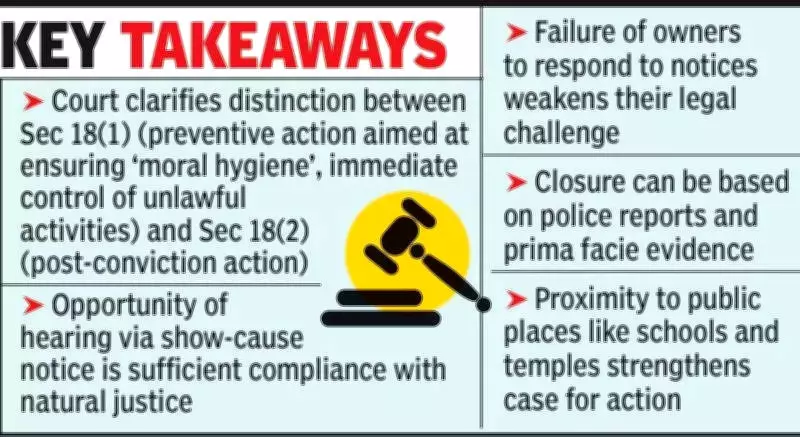
The court observed: "The powers under Section 18(1) are to be exercised for temporary closure after giving an opportunity of hearing, relying upon information that the premises was being used as a brothel." It stressed that such measures are preventive and do not require prior conviction of the owner.

Background of the Case
The case originated from a police raid in December 2023 at the hotel in Shirdi. During the operation, police conducted a decoy operation and recovered marked currency, mobile phones, condoms, and identified multiple women allegedly engaged in sex trade. Based on these findings, a proposal was sent to the magistrate for closure of the premises.
The petitioners, who owned the hotel, challenged the magistrate's order on several grounds:
- Violation of natural justice
- Lack of evidence regarding proximity to a public place
- Absence of conviction under Sections 3 or 7 of the Act
- Argument that the premises had been leased to another person, and no action could be taken without prosecuting the actual operator
Court's Reasoning and Legal Distinctions
Justice Pathan rejected all these arguments, noting that multiple notices had been served to the petitioners, who failed to respond. The court drew a crucial distinction between Sections 18(1) and 18(2) of the PITA.
"For taking action under Section 18(1), conviction of owner is not mandatory," the court held. It explained that conviction is a prerequisite only under Section 18(2), which applies in different circumstances, such as when the owner has been convicted of offenses under the Act.
Relying on Supreme Court precedents, Justice Pathan underlined the preventive intent of the law. The court cited that such powers are meant to ensure "moral hygiene in the locality" and act as a "quick-acting mechanism" to curb illegal activities. Observing that the hotel was located near a school, a shrine, and establishments frequented by devotees in Shirdi, the court found sufficient grounds to justify the action under Section 18(1).
Implications of the Ruling
This ruling reinforces the authority of magistrates to take swift action against premises suspected of being used for immoral trafficking, without waiting for lengthy criminal convictions. It highlights the balance between preventive measures and legal safeguards, ensuring that property owners are given a hearing opportunity before closure orders are issued.
The decision is expected to have broader implications for law enforcement agencies across Maharashtra and potentially other states, providing clearer guidelines on implementing the Immoral Traffic (Prevention) Act effectively. It underscores the judiciary's role in interpreting laws to address social evils while upholding procedural fairness.






