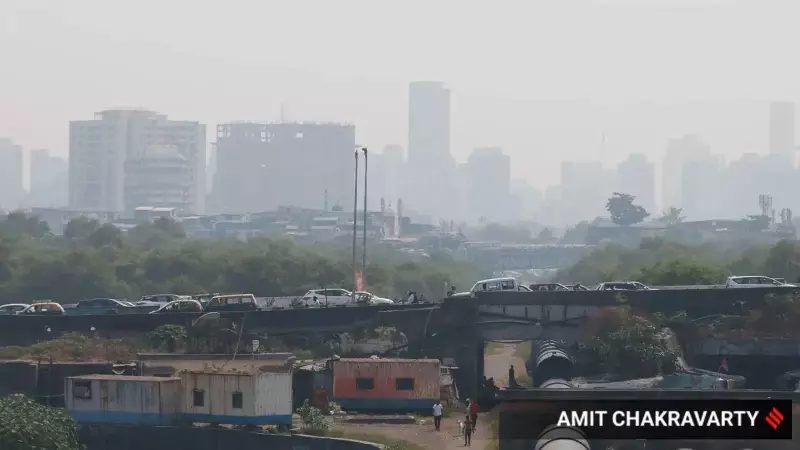
Bombay High Court Urges Civic Bodies to Factor Economic Consequences of Air Pollution
The Bombay High Court has issued a significant directive to municipal authorities in Mumbai and Navi Mumbai, emphasizing the need to consider the substantial economic impact of air pollution when formulating effective countermeasures. This judicial intervention highlights how environmental degradation transcends public health concerns to directly affect national economic stability.
Court's Directive on Pollution's Economic Dimension
During proceedings on Tuesday, a bench comprising Chief Justice Shree Chandrashekhar and Justice Gautam A Ankhad explicitly instructed the Brihanmumbai Municipal Corporation, Navi Mumbai Municipal Corporation, and the Maharashtra Pollution Control Board to incorporate economic considerations into their pollution control strategies. The court underscored that when pollution begins to detrimentally affect the nation's economy, it transforms into a matter of significant public interest requiring urgent attention.
The bench articulated, "It (report on economic impact) has given a different dimension to the issue of air pollution. So, this is also very important. You (authorities) please take a note of this. We do not think this aspect is examined in any of the judgments. If it is impacting nation's economy, then it is in public interest."

Expert Testimony on Economic Risks
The court's observations followed compelling submissions from amicus curiae Senior Advocate Darius Khambata, who referenced authoritative statements from Harvard University professor and former IMF Chief Economist Gita Gopinath. During her address at the World Economic Forum in Davos, Gopinath had emphasized that pollution represents a more substantial economic threat to India than conventional trade tariffs.
Khambata elaborated on this perspective, stating, "Pollution is a more serious and impactful source of depression on our economy while we discuss tariffs and trade agreements. People are getting handicapped and their efficiency levels are plummeting. The authorities should treat this as a crisis. The time has come for giving shock treatment to the authorities (through drastic orders)."
He further emphasized the urgency of political will, drawing a stark comparison to historical tragedies: "There has to be political will as we and our children are breathing in mini Bhopals. The time has come for stern action."
Supporting Evidence and Judicial Scrutiny
To substantiate his arguments, Khambata presented multiple evidentiary sources:
- News reports documenting Mumbai's record number of unhealthy Air Quality Index days in January 2026
- The comprehensive Lancet report titled "Health and economic impact of air pollution in the states of India: the Global Burden of Disease Study 2019"
When the Navi Mumbai civic body's counsel questioned the reliability of newspaper reports, Chief Justice Chandrashekhar firmly responded: "The credibility of these reports cannot be brushed aside like this. They are from responsible journalists and newspapers serving the nation."
Broader Judicial Observations and Directives
The court was hearing a suo motu Public Interest Litigation alongside other petitions addressing deteriorating air quality in Mumbai and surrounding regions. Beyond economic considerations, the bench made several critical observations and issued additional directives:

- Transparency Mandate: Civic authorities were instructed to establish dedicated websites providing real-time data from air quality monitoring stations, ensuring public accessibility. The bench emphasized, "People have a right to know and they must know."
- Compensation Framework: Senior Advocate Janak Dwarkadas, representing NGO Vanashakti, proposed that authorities should provide compensation to individuals who suffer hospitalization, health ailments, or fatalities due to pollution. He argued, "Life cannot be so cheap that authorities continue to conduct business as usual."
- Regulatory Oversight: The Maharashtra Pollution Control Board received instructions to conduct annual audits of industrial establishments, with particular focus on 'red category' highly polluting industries.
The court expressed concern about insufficient progress despite three years of judicial monitoring, noting: "In the last three years (since suo motu PIL initiated), we don't think any progress has been made by the authorities. Steps are taken but they are not sufficient. There could be a rise in the number of motor vehicles on the road, and constructions must have multiplied. That is perhaps why their efforts are not showing much positive impact."
Implications and Next Steps
This judicial intervention establishes a precedent by explicitly linking environmental protection with economic policy, recognizing that pollution control measures must account for their macroeconomic implications. The court has scheduled the next hearing for January 29, when further substantive orders are expected to be issued regarding implementation mechanisms and accountability frameworks.
The Bombay High Court's directive represents a paradigm shift in environmental jurisprudence, compelling authorities to view pollution not merely as a public health emergency but as a critical economic challenge requiring comprehensive, data-driven solutions with transparent public oversight.