The Bombay High Court has delivered a stern rebuke to the Brihanmumbai Municipal Corporation (BMC) for its failure to implement its own air pollution control guidelines. For the second day in a row, the court summoned BMC Commissioner Bhushan Gagrani, expressing deep frustration over the civic body's inaction in the face of deteriorating air quality in Mumbai.
Court Accuses BMC of "Doing Nothing"
The bench, comprising Chief Justice Shree Chandrashekhar and Justice Gautam Ankhad, was hearing a suo motu Public Interest Litigation (PIL) on the unchecked air pollution in the city. The judges accused the BMC of "doing nothing" to curb pollution and highlighted its poor oversight, which has failed to ensure dust-mitigation measures at numerous construction sites across Mumbai.
The court emphasized that stopping construction work is not a viable solution. Instead, it insisted on constant and surprise monitoring with coordinated reporting from the ground. The bench only relented after receiving "concrete suggestions" to control non-compliant sites.
New Directives for Surprise Inspections
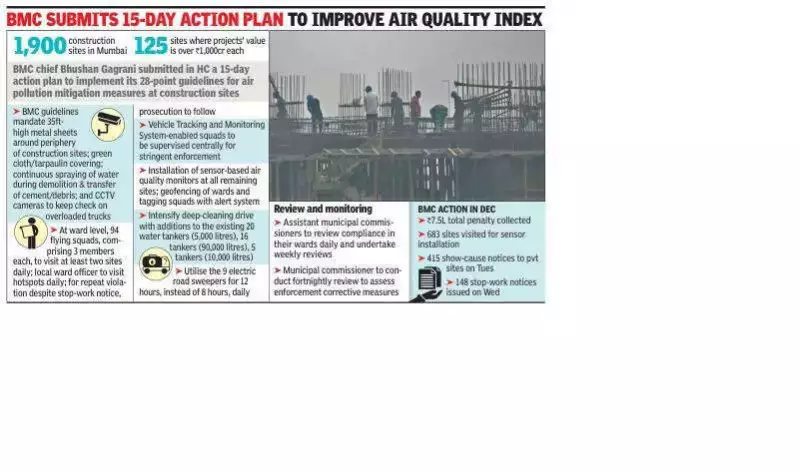
The High Court issued specific orders to rein in the pollution. It directed that civic squads must begin "random, but periodic surprise visits daily" starting from December 29, 2024. Furthermore, the BMC has been instructed to widely publicize its 28-point guidelines aimed at improving the city's Air Quality Index (AQI) through various media channels.
To ensure the integrity of these inspections, the HC made innovative suggestions. It proposed that squad members be equipped with button cameras and GPS trackers. Crucially, the judges stated that members should not carry their personal cellphones during site visits, with only one phone kept with the driver for emergencies. "No one should know of the visit," Chief Justice Chandrashekhar stressed, underlining the need for genuine, unannounced checks.
Focus on Major Projects and Creating Fear
The court questioned why compliance was so lax, pointing out that there are at least 125 major construction projects in the city, each worth a minimum of Rs 1,000 crore. It noted that such large-scale projects can easily afford the cost of implementing pollution-mitigating measures.
Senior counsel Darius Khambata, assisting the court as amicus curiae, suggested that the inspection squads could begin with at least the 36 sites previously visited by an HC-appointed inspection committee. The bench agreed that there should be "fear in the mind of project proponents" and directed the BMC to publish the consequences of non-compliance with pollution norms.
During the hearing, the court grilled the BMC on widespread non-compliance. When the BMC's senior counsel S U Kamdar stated that only 39 out of 94 squads visited sites since the previous day, the court expressed dissatisfaction. The explanation that many staff were on election duty did not impress the judges, who remarked that the BMC should have sought exemption from the Election Commission.
Janak Dwarkadas, senior counsel for the intervenor NGO Vanshakti, pointedly remarked, "It appears the right to life of citizens is subservient to election duty." He suggested that the BMC must stop granting new construction permissions if compliance at existing sites remains a problem—a suggestion with which the High Court orally agreed.
Broader Measures and Future Hearing
The hearing also covered broader measures. Tejesh Dande, counsel for the Navi Mumbai Municipal Corporation (NMMC), informed the court that the civic body plans to add 52 more AQI monitors every 2 square kilometers within six months and wants CCTV cameras at every construction site.
The Chief Justice also inquired about steps for the safety of construction workers. Ashutosh Kumbhakoni, senior counsel for the Maharashtra Pollution Control Board (MPCB), stated that a panel has been set up to meet with the labour board. He also reported that out of 22 Ready-Mix Concrete (RMC) sites visited, seven were found non-compliant.
The Bombay High Court has now posted the matter for further hearing on January 20, 2026, to monitor compliance with its directives.