Bombay High Court Dismisses 2019 Criminal Case Against Former Akola Corporator
The Nagpur Bench of the Bombay High Court has recently quashed a criminal case from 2019 against a former corporator from Akola, delivering a significant ruling on legal standards for obscenity and extortion charges under the Indian Penal Code (IPC).
Court's Ruling on Obscenity and Extortion Allegations
In a detailed judgment, Justice Urmila Joshi Phalke allowed a criminal application filed through counsel Raheel Mirza, setting aside the FIR registered at Civil Lines Police Station in Akola. The court emphasized that "mere abuses are not sufficient to attract the offence punishable under Section 294 of IPC," which penalizes obscene acts and songs performed in public. Additionally, the allegations of extortion were found to be unsupported by evidence, leading to the quashing of the FIR and all consequential proceedings.
Background of the Case and FIR Details
The case originated from an FIR lodged by a businessman, who alleged that on April 25, 2019, the petitioner, a former Akola corporator, entered his ready-made garment shop. The petitioner was accused of selecting shirts without payment, abusing staff, forcibly taking ₹4,000, and threatening and assaulting employees. The FIR invoked multiple sections of the IPC, including:
- Section 389: Putting a person in fear of accusation to commit extortion
- Section 384: Punishment for extortion
- Section 385: Putting a person in fear of injury in order to commit extortion
- Section 34: Acts done by several persons in furtherance of common intention
Petitioner's Defense and Court's Observations
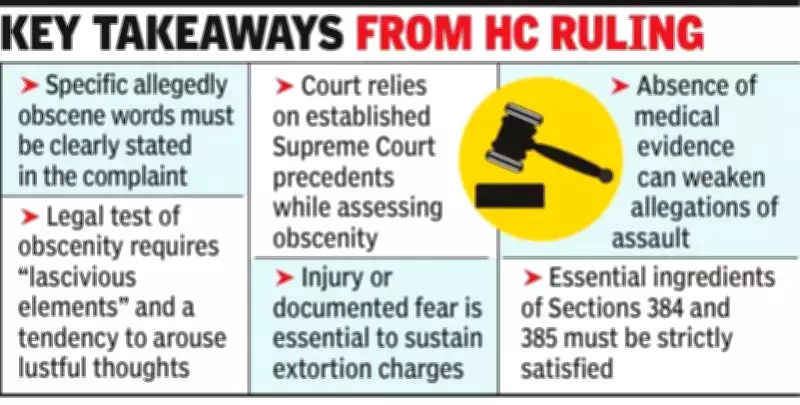
The petitioner contended that the complaint stemmed from political rivalry and pointed to medical records that did not substantiate the claims of assault. The court noted that injury certificates did not reflect any harm to those present during the alleged incident. Justice Phalke observed, "On perusal of the FIR, it reveals that the respondent alleged that he was abused by the petitioner, but the exact abuses are not narrated by him." Even if such allegations under Section 294 were accepted, the court stated that "the test of obscenity is to be fulfilled."
Legal Precedents and Standards for Obscenity
Citing Supreme Court rulings in NS Madhanagopal versus K Lalitha and Ranjit Udeshi versus State of Maharashtra, the judge reiterated that obscenity requires a "substantial tendency to corrupt by arousing lustful desires" and the presence of "lascivious elements." The court held that the allegations in this case did not meet these stringent criteria, thereby failing to establish an offence under Section 294 of the IPC.
Analysis of Extortion Charges
Regarding the extortion charges under Sections 384 and 385 of the IPC, the court found that the essential ingredients were not met. The judge stated, "There is nothing on record to show that the respondent or any other employee of his shop were put under fear or any injuries were caused to them to hand over the said amount of extortion." This lack of evidence led to the conclusion that the extortion allegations were baseless.
Conclusion and Implications
In its final ruling, the court declared, "In view of the above observation… the offence under Section 294 of IPC is also not made out," thereby quashing the FIR and all related proceedings. This decision underscores the importance of concrete evidence in criminal cases and clarifies the legal thresholds for obscenity and extortion under Indian law, potentially setting a precedent for similar future cases.