Bombay High Court Upholds Legality of Mobile Phone Summons Under BNSS
In a landmark decision that clarifies the role of electronic communication in criminal law, the Nagpur bench of the Bombay High Court has ruled that serving summons through a mobile phone is legally valid under the Bharatiya Nagarik Suraksha Sanhita (BNSS), 2023. The court set aside a previous order that imposed costs on a police constable for using this method, emphasizing the statutory recognition of digital processes in the justice system.
Background of the Case
The case originated from a January 21 order by a special Pocso court in Nagpur, which directed the recovery of costs from Constable Santosh Ramteke. The trial court had argued that summons served via mobile phone was "not allowed", citing the absence of two prosecution witnesses and delays in recording evidence in a pending special case. The Maharashtra government, represented by senior counsel and government pleader Deven Chauhan along with assistant public prosecutor A M Kadukar, challenged this order by filing a criminal application on behalf of the Lakadganj police station.
High Court's Legal Analysis
Justice Urmila Joshi-Phalke, presiding over the case, quashed the trial court's order after examining the relevant provisions of the BNSS. The state argued that the trial court overlooked Sections 70 and 530 of the BNSS. Specifically, Section 70(3) provides that "all summons served through electronic communication" shall be considered duly served, while Section 530 permits trials, inquiries, and proceedings, including the service of summons, to be conducted in electronic mode.
Justice Joshi-Phalke observed that "there is amended provision in view of Section 70 of BNSS", and that electronic service is "very well accepted by the amendment". The court further noted that the primary purpose of serving summons is to put a person on notice, and "the mode is surely irrelevant". This ruling underscores the flexibility and modernization intended by the BNSS in adapting to technological advancements.
Factual Errors and Implications
The bench also identified factual errors in the trial court's reasoning. It was recorded that the witnesses were initially served on November 3, 2025, and reissued summons were not handed over to the concerned constable for service. By setting aside the order in the special case, the court directed that the recovery of costs from the officer stands quashed. This decision not only rectifies an individual injustice but also sets a precedent for future cases involving electronic communication.
Key Takeaways from the High Court Order
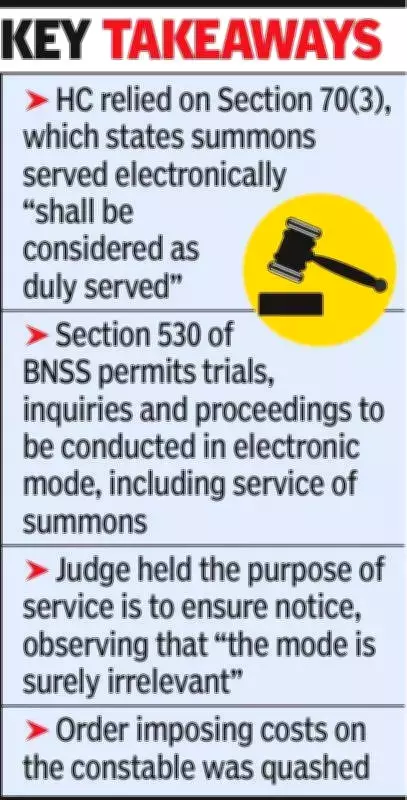
- The court relied on Section 70(3) of the BNSS, which states that summons served electronically "shall be considered as duly served".
- Section 530 of the BNSS permits trials, inquiries, and proceedings to be conducted in electronic mode, including the service of summons.
- The judge held that the purpose of service is to ensure notice, emphasizing that "the mode is surely irrelevant".
- The order imposing costs on the constable was quashed, reinforcing the legal validity of digital processes.
- This ruling strengthens the statutory framework for digital integration in criminal justice administration, promoting efficiency and accessibility.
Overall, this ruling by the Bombay High Court marks a significant step forward in aligning India's criminal justice system with contemporary digital practices, ensuring that legal procedures remain relevant and effective in the modern era.