The Bombay High Court on Tuesday issued a significant directive to municipal and pollution control authorities, urging them to seriously consider examining the profound economic consequences of deteriorating air quality in the Mumbai Metropolitan Region. The oral instructions came from a bench comprising Chief Justice Shree Chandrashekhar and Justice Gautam Ankhad during a crucial hearing on a suo motu Public Interest Litigation addressing the worsening air pollution crisis.
Court Cites IMF Economist's Stark Warning
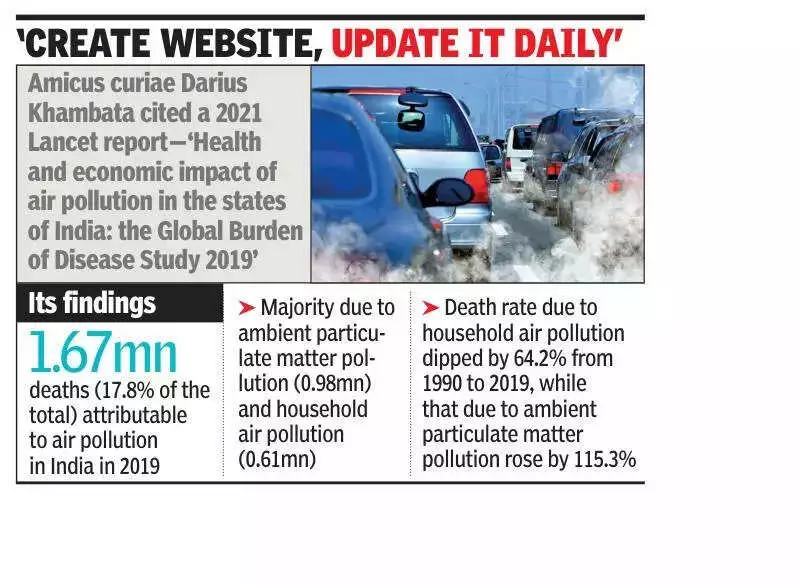
Amicus curiae Darius Khambata, who is assisting the court in this matter, brought attention to recent statements by former IMF chief economist Gita Gopinath. He highlighted her assessment that pollution currently represents India's most significant economic challenge, surpassing even global tariff issues in its impact. Khambata emphasized Gopinath's data indicating that air pollution causes approximately 1.7 million annual deaths in India, accounting for 18% of total fatalities, while simultaneously costing the nation a staggering $339 billion annually, equivalent to 9.5% of its Gross Domestic Product.
"People Are Dying, Production Is Falling"
"People are dying, getting handicapped, production level is going down... Authorities keep coming with plea for time... Some shock treatment has to be given," Khambata told the court with evident urgency. In response to this compelling argument, Chief Justice Chandrashekhar directly addressed senior counsel representing the Brihanmumbai Municipal Corporation and Navi Mumbai Municipal Corporation, stating clearly: "Economic impact is also very important. Please take note of this." The Chief Justice noted that this crucial economic dimension had not been sufficiently raised in previous proceedings.

Transparency and Accountability Demands
The court proceedings revealed multiple concerns about transparency and effectiveness in pollution control measures. Khambata referenced a January 26 Times of India report detailing suggestions from Virendra Sethi, a scientist and member of the High Court's air quality panel, who proposed creating a dedicated force within the Mumbai Metropolitan Region specifically to combat pollution. Khambata further pointed to Air Quality Index data appearing in news reports, suggesting discrepancies between official claims and ground reality.
"The AQI data cited in news reports suggested that either the authorities are not telling the High Court what they are doing has not worked, or they are not doing what they said on affidavit," Khambata asserted. In response to these transparency concerns, the High Court made a practical suggestion to municipal bodies: "Create a website and put a daily update. So AQI and every data received from control centers becomes available to everyone." Anil Anturkar, senior counsel for NMMC, assured the court that his client would implement this recommendation.
Proposals for Enhanced Monitoring and Compensation
The hearing saw several progressive suggestions from various stakeholders. Khambata, along with senior counsel Janak Dwarkadas representing NGO Vanshakti, proposed establishing a fresh monitoring panel that would include independent citizen participation to ensure greater accountability. Dwarkadas went further, advocating for a compensation mechanism: "Let there be compensation. All authorities must be made to pay for victims who suffer pollution-led setback. Else, there is no consequence."
Pollution Control Board's Industrial Audit
Senior counsel Ashutosh Kumbhakoni, representing the Maharashtra Pollution Control Board, provided specific data about industrial polluters. He clarified that there are 2,178 industries in the "red category" (designating high polluters) in the region, not the previously mentioned figure of over 7,000. Kumbhakoni informed the court that these industries underwent audits from June 2024 through March 2025, with reports already submitted. While acknowledging this effort, Chief Justice Chandrashekhar emphasized the need for regular oversight: "There must be a yearly audit... but it can't be a year-long process."

Environmental Groups Offer Additional Solutions
The Conservation Action Trust, intervening through environmentalist Debi Goenka, presented multiple suggestions for addressing the pollution crisis. The court acknowledged these contributions while underscoring the seriousness of the matter. "We are very serious," Chief Justice Chandrashekhar stated definitively, indicating that the High Court would pass formal orders following the next scheduled hearing on Thursday.
This judicial intervention marks a significant escalation in addressing Mumbai's air quality emergency, moving beyond health concerns to explicitly recognize the substantial economic burden of pollution. By directing authorities to examine this economic dimension while demanding greater transparency and accountability, the Bombay High Court has positioned environmental protection as both a public health imperative and an economic necessity for India's financial capital.