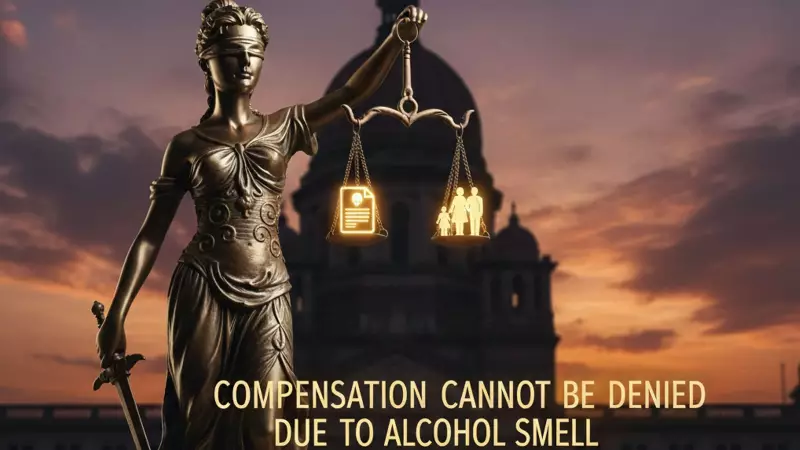
In a significant ruling, the Calcutta High Court has held that the mere mention of an alcoholic smell in a post-mortem report cannot be the sole ground for an insurance company to deny compensation to the legal heirs of an accident victim. The court underscored that concrete proof of intoxication, as per the Motor Vehicles Act, is required.
Court Dismisses Insurance Company's Appeal
The judgment was delivered by Justice Biswaroop Chowdhury on December 12, while dismissing an appeal filed by The New India Assurance Company Limited. The appeal challenged a Motor Accident Claims Tribunal order from Tamluk dated May 22, 2024. The tribunal had awarded a compensation of Rs 11.41 lakh with 6% interest to the mother and kin of victim Ganesh Das.
The fatal accident occurred on December 27, 2020, when Ganesh Das, riding a motorcycle, was hit by a rashly and negligently driven truck. He died on the spot. The insurance company contested the tribunal's order, citing two primary reasons. First, it claimed the deceased was driving drunk, as the post-mortem report noted an alcoholic smell in his stomach. Second, it argued that Das's motorcycle was uninsured and the compensation amount was excessive.
What Constitutes Proof of Drunken Driving?
The High Court provided a crucial interpretation of the law regarding drunken driving allegations in fatal accidents. Justice Chowdhury observed that for prosecution under Section 185 of the Motor Vehicles Act, intoxication must be established by proving that the blood alcohol content exceeded the prescribed legal limit.
"In the absence of any breath analyser or blood alcohol test, the mere smell of alcohol could not conclusively establish drunken driving," the bench stated. The court clarified that while driving drunk is a prosecutable offence and can be a ground for contributory negligence, the heirs of a deceased victim cannot be deprived of compensation because the victim is not alive to defend themselves against the allegation.
Court's Rationale and Other Observations
The bench emphasized that the claim was against the insurer of the offending truck, not the insurer of the victim's motorcycle. Therefore, the fact that Das's bike was uninsured was held to be an irrelevant defence, as there was no contractual relationship between the appellant insurer and the bike's owner.
Furthermore, the High Court upheld the tribunal's assessment of the victim's monthly income at Rs 5,000. The claimants, who had filed cross-objections seeking enhanced compensation by claiming Das earned Rs 15,000 per month, failed to prove the higher income by examining his employer or producing documentary evidence.
In a notable aside, the court also advised insurance companies to inform transport authorities when vehicles continue to ply on roads without renewing their expired insurance policies, despite reminders.
This ruling reinforces the legal standards required to prove drunken driving in compensation cases and protects the rights of victims' families when direct scientific evidence is absent.