

The Calcutta High Court has ruled that the mere involvement of a vehicle in an accident cannot lead to criminal charges under animal cruelty laws unless there is evidence of intent to cause harm. This judgment came as the court quashed a criminal case against a Howrah man accused of running over a stray dog.
Court's Observation on the Incident
Justice Ajoy Kumar Mukherjee, presiding over a single bench, described the incident as 'at best an unfortunate road accident.' He noted that there was no evidence to suggest that the driver deliberately or knowingly caused the stray dog's death.
Details of the Case
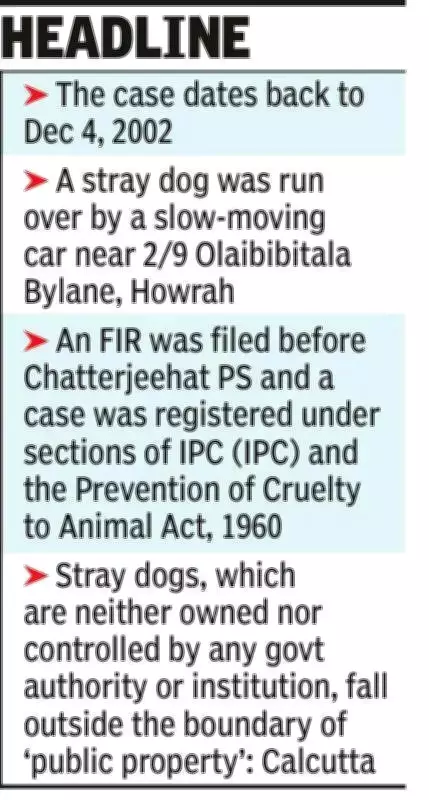
The case dates back to December 4, 2002, when a stray dog was run over by a slow-moving car near 2/9 Olaibibitala Bylane, Howrah. An FIR was lodged at Chatterjeehat Police Station, and a case was registered under sections of the Indian Penal Code (IPC) and the Prevention of Cruelty to Animal Act, 1960.

The complainant alleged that the driver deliberately ran over the stray dog. Two witnesses claimed that the vehicle was moving slowly to specifically target the animal. The dog was said to have died on the spot, but no photographic evidence, veterinarian's certificate, or official record was produced to confirm what happened after the incident.
Defense Arguments
The driver's defense argued that the 'slow movement' of the car was inconsistent with any intent to harm. They contended that a deliberate attempt to kill an animal would more likely involve speeding or overt aggression. It was also pointed out that the driver lived barely 20 meters from the spot of the incident.
Legal Analysis by the High Court
Justice Mukherjee held that the case, registered under Sections 428 and 429 of the IPC, 'falls flat.' He explained: 'Admittedly the dog was a stray dog and as I have stated above that there was no owner of stray dog and also was not the property which could be subjected to the offence of Section 429 IPC. Section 429 provides mischief by killing, poisoning, maiming or rendering useless any elephant, camel, horse, mule, buffalo, bull, cow or ox whatever may be value or any other animal of the value of Rs 50 or upwards but such property should be public property or property to any person.'
The judge clarified that stray dogs, which are neither owned nor controlled by any government authority or institution, fall outside the boundary of 'public property.'
Application of the Prevention of Cruelty to Animal Act
Regarding punishment under Section 11(1)(a) of the Prevention of Cruelty to Animal Act, which penalizes anyone who beats, kicks, overrides, overdrives, overloads, tortures, or otherwise treats any animal in a way that subjects it to unnecessary pain or suffering, the High Court held that the claim of cruelty under the Act demands at least some demonstration of unnecessary pain inflicted with purpose. There is no evidence showing the dog's alleged injury or even its death, which has not been conclusively proved.






